
AI Developer Tools September 2026: New APIs and Frameworks
AI Developer Tools September 2026: New APIs and Frameworks
Building with AI in September 2026 is materially different from a year ago. The infrastructure has improved, costs have dropped, and the developer experience around AI integrations has matured. For developers actively building AI applications, this week brought several noteworthy updates worth tracking.
The API Landscape: What Has Changed
The large language model API market has become more competitive and more standardized in the past 12 months. The practical benefits for developers:
Lower costs: Inference prices have dropped consistently. Tasks that cost $1 per 1000 requests in early 2025 now cost a fraction of that. This changes the economic calculus for applications that seemed too expensive to build at earlier price points.
Better rate limits: Hyperscalers and major AI labs have invested significantly in capacity. Rate limiting and throttling, a chronic frustration in 2024-2025, is no longer a daily obstacle for most production applications.
More consistent latency: Inference latency has improved and, more importantly, become more predictable. Applications that require sub-second response times can now build reliable experiences on top of major API providers.
Emerging API standardization: Informal standardization around request and response formats has reduced the friction of switching between providers. Routing requests across multiple providers — for cost, latency, or capability reasons — is now a realistic architecture for serious applications.
Agentic Frameworks: Maturity Has Arrived
The agentic AI framework landscape, which was chaotic and rapidly evolving in 2024, has substantially consolidated and matured. Developers in September 2026 are working with tools that have real production track records.
Key patterns in production agentic frameworks:
- Tool-calling reliability: Early agentic systems were unreliable in tool selection and sequencing. Current frameworks have improved significantly, with structured output support and better tool description parsing reducing failure rates in production.
- Memory and context management: Long-running agent tasks require managing context across multiple model calls. The libraries for doing this correctly — managing what to retain, what to summarize, and what to discard — are now well-established.
- Observability: Debugging agentic systems used to require extensive custom instrumentation. Current frameworks emit structured traces that integrate with standard observability platforms.
- Human-in-the-loop patterns: Production agentic applications increasingly need defined points where humans review, approve, or redirect agent actions. Framework support for pause-and-check patterns has improved substantially.
For a broader look at how AI agents are deployed in enterprise contexts, our AI multi-agent systems coverage provides architectural context.
Coding Assistants: The Market Has Segmented
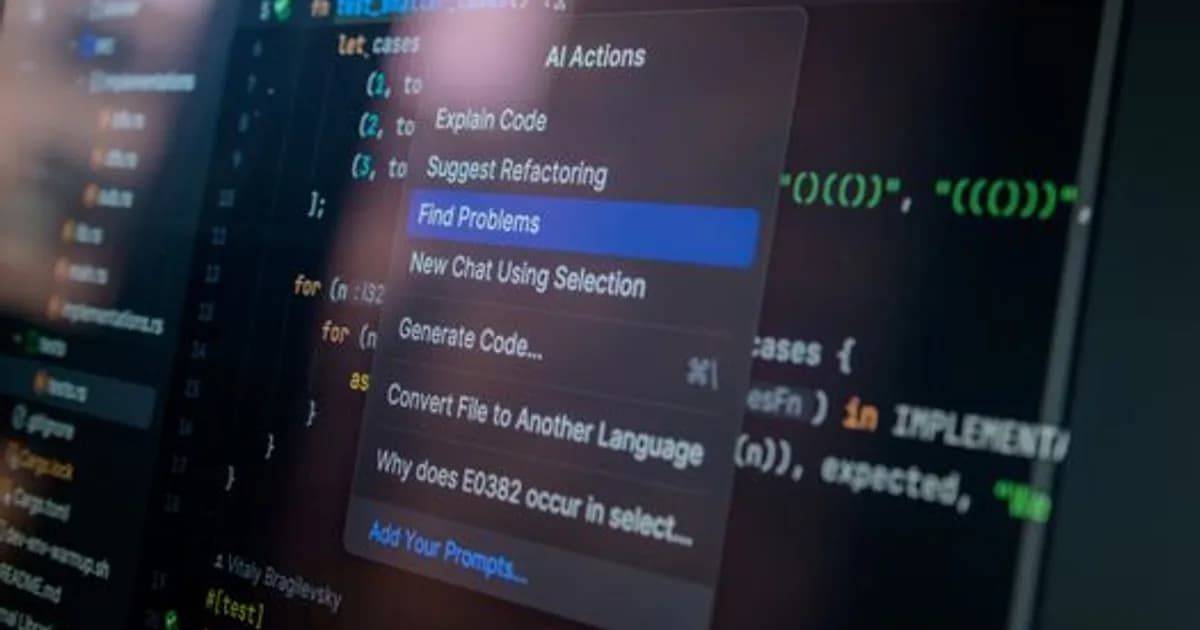
The AI coding assistant market has matured into distinct segments in 2026. The "everyone gets the same AI autocomplete" model of early products has given way to differentiated tools for different development contexts:
- General-purpose assistants: Tools integrated into IDEs that handle completion, explanation, and refactoring across languages. This category is highly competitive, with multiple strong options.
- Code review tools: AI systems that analyze PRs for bugs, performance issues, security vulnerabilities, and style inconsistencies. These have moved from novelty to standard infrastructure at many engineering organizations.
- Testing assistants: Tools that generate unit tests, identify test coverage gaps, and flag code paths that lack adequate testing. Early products were unreliable; 2026 tools are good enough for integration into CI/CD pipelines.
- Architecture and design tools: Newer, less mature tooling that helps with higher-level design decisions — API design, data model design, system architecture review.
See our detailed AI coding tools comparison for August and coding assistants comparison for September for evaluation of specific tools.
Retrieval-Augmented Generation (RAG): Operational Maturity
RAG systems — combining LLMs with retrieval from specific document sets — have become standard infrastructure for enterprise AI applications that require knowledge grounding. The technology is well-understood, but the operational challenges of building reliable, high-quality RAG systems remain real.
September 2026 advances in RAG include:
- Hybrid retrieval: Combining dense vector retrieval with sparse keyword retrieval consistently outperforms either method alone. This is now standard practice in production systems.
- Re-ranking models: Small models that re-rank initial retrieval results before passing them to the LLM have become a standard component in high-quality RAG pipelines, improving precision substantially.
- Evaluation frameworks: Robust evaluation of RAG systems — measuring retrieval quality, factual accuracy, and attribution — has matured. Teams can now measure the quality of their RAG systems rigorously rather than relying on qualitative assessment.
- Chunking strategies: The field has moved past naive fixed-size chunking to semantically-aware chunking that respects document structure and topic boundaries.
Our enterprise RAG article covers the production architecture patterns in more detail.
Multimodal APIs: New Capabilities Available
Multimodal capabilities have expanded significantly in APIs available to developers this week. New features across major providers include:
- Native audio input/output: Processing audio directly without a transcription step reduces latency and preserves prosodic information that text transcription loses
- Document understanding: Structured parsing of complex document layouts — tables, forms, charts — that goes beyond simple text extraction
- Video understanding: Reasoning over video content, including temporal relationships and action sequences
For developers building applications that involve non-text inputs, the capability step change in the past six months is significant. Use cases that would have required custom models or complex pipelines can now be addressed with API calls.
Pricing Optimization: Not All Tokens Are Equal
One underappreciated development in the 2026 developer tool landscape is the sophistication of pricing structures. Major API providers now offer:
- Tiered pricing by model size: Developers can route requests to appropriately-sized models based on task complexity, paying premium prices only for tasks that require frontier-model capability
- Batch processing discounts: Tasks that do not require real-time results can be submitted as batch jobs at significantly reduced prices
- Caching: Repeated identical inputs are served from cache at reduced cost — important for applications with common system prompts or high-frequency identical queries
- Regional pricing variation: Costs vary by deployment region, creating optimization opportunities for global applications
Building a cost optimization layer into AI application architecture — rather than routing everything to the most capable (and most expensive) model — has become a standard engineering practice for production applications.
For broader context on the AI developer ecosystem, see our AI autonomous coding coverage and the AI developer experience overview. The best AI coding assistants 2026 guide provides a comprehensive tool comparison.
Comments
Loading comments...