
AI in Supply Chain Management 2026: Automate, Optimize
AI in Supply Chain Management 2026: Automate and Optimize
AI in supply chain management has moved from pilot project to core infrastructure at most large manufacturers and retailers. The tools have matured, the ROI is measurable, and the companies that haven't adopted AI-driven supply chain processes are now noticeably behind.
This article covers what AI supply chain tools actually do, which platforms lead in 2026, and how to think about implementation.
What AI Supply Chain Tools Actually Do
Supply chain AI covers a broad range of tasks. The unifying thread is that these systems process large amounts of structured and unstructured data — sales history, supplier lead times, weather data, shipping delays, raw material prices — and turn it into decisions or recommendations faster than any human team could.
The main capabilities in production use today:
- Demand forecasting — predicting what customers will order, when, and in what quantity
- Inventory optimization — setting stock levels that minimize both stockouts and excess inventory costs
- Supplier risk monitoring — flagging early signals that a supplier may experience delays or quality issues
- Transportation optimization — routing shipments more efficiently across carrier networks
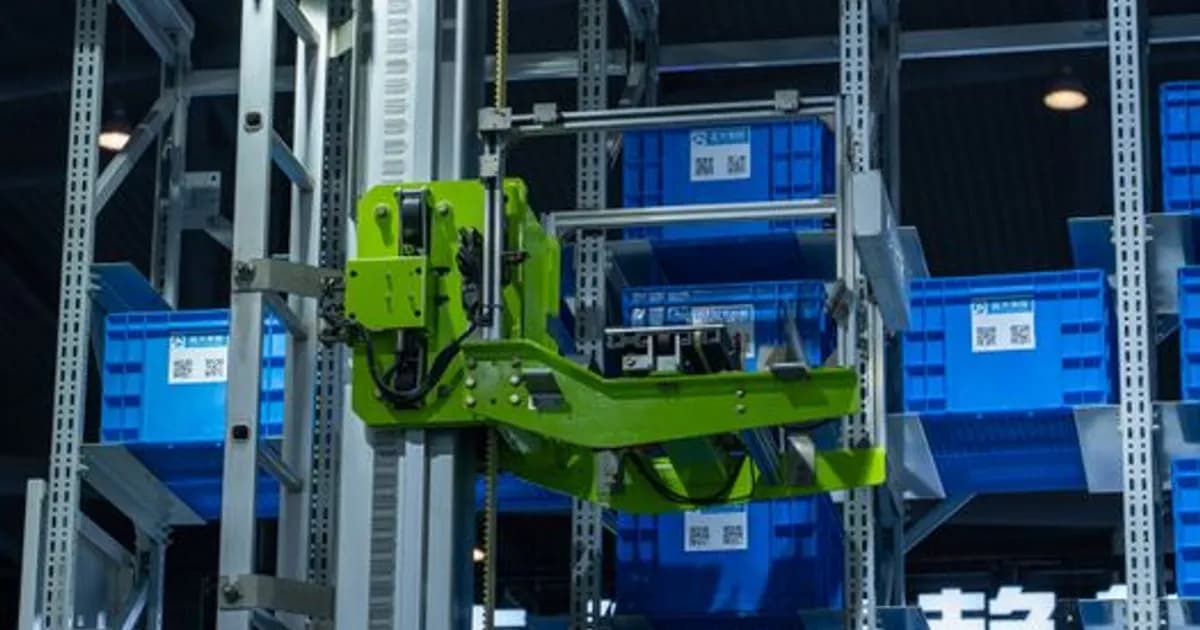
- Warehouse automation — coordinating picking, packing, and replenishment with minimal manual intervention
Most enterprise platforms now bundle several of these into integrated suites rather than selling them as point solutions.
Leading AI Supply Chain Platforms in 2026
The market for AI supply chain software is consolidating. A handful of platforms have pulled ahead by combining broad functionality with strong integration into ERP systems like SAP and Oracle.
Blue Yonder remains one of the most widely deployed platforms at large manufacturers. Its strength is demand-sensing — using real-time signals to adjust forecasts faster than traditional statistical models.
o9 Solutions has grown its enterprise footprint with a connected planning platform that spans demand, supply, and financial planning in a single data model. It's particularly strong for companies that need tight alignment between supply chain and finance.
Kinaxis RapidResponse is widely used in automotive and industrial manufacturing. Its scenario-modeling capabilities let planners quickly test how disruptions — a port closure, a supplier quality issue — propagate through the supply network.
Coupa and Jaggaer lead in the procurement-focused subset of supply chain AI, helping companies manage supplier relationships, contract compliance, and spend analysis.
For smaller companies, lighter-weight tools built on top of warehouse management systems or ERP modules are often the right starting point before investing in a standalone platform.
How AI Demand Forecasting Works in Practice
Traditional demand forecasting relies on historical sales data and seasonal patterns. AI demand forecasting layers in dozens of additional signals.
A beverage company, for example, might feed its forecasting model sales history, promotional calendars, weather data, local event schedules, and social media sentiment about their brand. The model learns which combinations of signals predict demand spikes and can update forecasts daily rather than monthly.
The accuracy improvements are real. Companies that have moved from statistical to AI-based forecasting typically report 20-40% reductions in forecast error, which directly reduces both stockouts and overstock costs.
The key implementation challenge is data quality. AI forecasting is only as good as the historical data it trains on. Companies with inconsistent product hierarchies, messy point-of-sale data, or siloed systems often need significant data cleanup before AI forecasting delivers its full value.
Inventory Optimization: Reducing Capital Tied Up in Stock
Excess inventory is expensive. It ties up working capital, occupies warehouse space, and creates write-off risk. Insufficient inventory loses sales and damages customer relationships.
AI inventory optimization models calculate optimal stock levels for each SKU at each location, accounting for demand variability, supplier lead times, and the cost tradeoffs between holding inventory and expediting shipments.
In practice, companies using AI inventory optimization are carrying 10-25% less inventory for the same or better service levels. At large retailers and manufacturers, that represents hundreds of millions of dollars in freed-up capital.
The technology has also enabled finer-grained decisions. Rather than setting a single reorder point for a product category, AI systems can differentiate by location, season, and customer segment.
Supplier Risk Management With AI
Supply chains have become more volatile. The past several years produced port closures, geopolitical disruptions, raw material shortages, and factory fires. Companies that relied on single-source suppliers with no visibility into sub-tier risk paid a steep price.
AI supplier risk tools monitor a wide range of signals — financial news, shipping data, weather events, political developments, supplier financial health indicators — and surface early warnings before disruptions hit.
Some platforms now use natural language processing to scan supplier-related news and regulatory filings in multiple languages, giving procurement teams visibility into risks that would otherwise require teams of analysts.
This connects to broader trends in AI for enterprise operations covered in AI in ERP Systems 2026: Transforming Enterprise Operations.
ROI and Implementation Timeline
The ROI on AI supply chain investments is well-documented for large enterprises, but the implementation timeline is often longer than expected.
A realistic timeline for a mid-to-large enterprise looks like:
- Months 1-3: Data audit, integration planning, platform selection
- Months 4-8: Data integration, model training, user training
- Months 9-12: Pilot deployment in one region or product line
- Year 2: Full rollout, continuous model improvement
The biggest implementation risks are data quality issues discovered mid-project, change management (supply chain planners who distrust AI recommendations), and integration complexity with legacy ERP systems.
Companies that go in with realistic expectations and strong executive sponsorship consistently deliver better outcomes than those treating supply chain AI as a pure technology project.
Getting Started: What to Do First
For companies early in their AI supply chain journey, the highest-value starting point is usually demand forecasting. It has the most established tooling, the clearest ROI, and the shortest implementation cycle.
Before evaluating platforms, spend time on the data side:
- Audit the completeness and consistency of your sales history data
- Map your current forecast process and where errors are most costly
- Identify which ERP and WMS systems need to integrate with a new platform
Once the data foundation is solid, the AI layer delivers results much faster.
For context on how AI is being applied across logistics and operations more broadly, AI in Logistics 2026: How Last-Mile Delivery Gets Smart covers the transportation side of this ecosystem.
AI supply chain management is no longer optional for companies competing at scale. If your organization is still running on spreadsheets and monthly statistical forecasts, the gap to AI-enabled competitors is widening. Start with a focused pilot — demand forecasting in your highest-volume segment — and build from there.
Comments
Loading comments...