
AI Vertical Farming in 2026: Growing Food Indoors Now
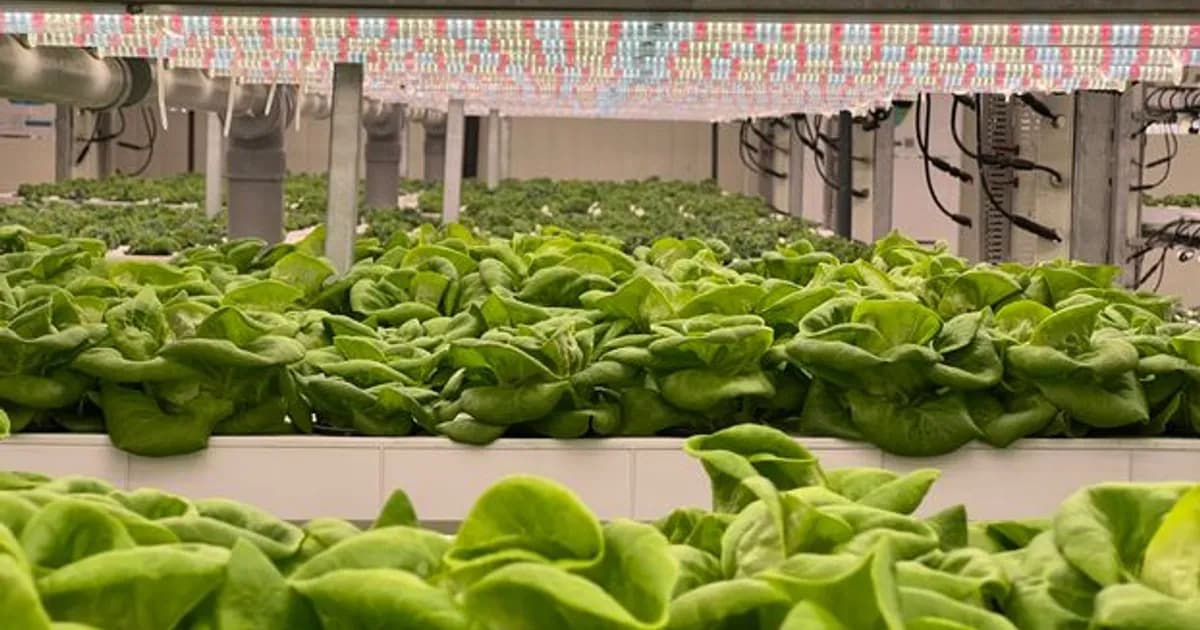
AI Vertical Farming in 2026: Growing Food Indoors
AI vertical farming has moved from a venture-funded novelty to a more grounded part of the controlled-environment agriculture industry in 2026, with AI doing the heavy lifting of a problem that's genuinely difficult to manage manually: optimizing light spectrum, nutrient dosing, temperature, and humidity simultaneously across thousands of plants, in real time, without a human able to physically check every tray throughout the day.
That optimization problem is exactly where machine learning has the clearest advantage, since the variables interact with each other in ways that aren't intuitive even to experienced growers, and small adjustments compound significantly over a full growing cycle.
Why Indoor Growing Needs This Level of Precision
Vertical and indoor farms trade the unpredictability of weather and soil for complete environmental control, but that control only pays off if it's tuned well. Every variable a grower can now adjust — light intensity and spectrum, irrigation timing, nutrient concentration, CO2 levels, airflow — also has to be paid for through energy and resource costs, so the economic case for indoor farming depends heavily on getting that tuning close to optimal rather than just functional.
AI models trained on sensor data and yield outcomes across many growing cycles have gotten meaningfully better at finding combinations that improve yield and quality without just throwing more energy at the problem, which matters enormously for operations where electricity for lighting is often the single largest recurring cost.
What the Systems Actually Control
A modern AI-managed vertical farm typically automates several layers of environmental management together rather than tuning them independently:
- Dynamic lighting, adjusting spectrum and intensity by growth stage rather than running a fixed schedule, since different growth phases respond to different light conditions
- Nutrient dosing, calibrated continuously against sensor readings of the growing medium rather than a fixed feeding schedule
- Climate control, balancing temperature, humidity, and CO2 levels against the specific crop's optimal range at each growth stage
- Computer vision crop monitoring, flagging early signs of nutrient deficiency, pest pressure, or disease from leaf color and growth pattern changes before a human inspection would likely catch them
The integration across these systems matters more than any single component, since a lighting adjustment that improves growth rate can also shift the optimal nutrient and humidity levels, and treating each variable in isolation tends to under-deliver compared to optimizing them together.
The Economics Are Still the Real Constraint
Despite genuine yield and resource-efficiency gains from AI optimization, vertical farming as an industry has had a rockier financial run than its early hype suggested, with several high-profile ventures scaling back or closing entirely. AI-driven efficiency gains have helped at the margins, but they haven't fundamentally changed the underlying economics: indoor growing remains energy-intensive, and for most crop types, it still struggles to compete on cost with conventional field agriculture except for high-value, fast-turnover crops like leafy greens and herbs grown near urban markets where freshness and transport savings add real value.
This economic reality connects to the broader resource-tradeoff questions running through AI and Renewable Energy in 2026: Solving the Power Crisis, where energy-intensive AI-managed operations increasingly depend on cheaper, cleaner power to make their underlying economics work at all.
Where AI Optimization Has Made the Clearest Difference
The strongest results have come from operations growing a narrow set of crops at meaningful scale, where AI models can accumulate enough cycle-over-cycle data on a specific crop variety to optimize confidently. Operations trying to grow a wide variety of crops with limited data on each have generally seen smaller gains, since the models simply don't have enough comparable history to learn from.
This data-dependency pattern is consistent with how AI agricultural tools perform more broadly, as described in AI in Agriculture 2026: Smart Farming Takes the Field, where outdoor precision farming systems show the same pattern of stronger results concentrating around well-studied crops with abundant historical data.
The UN Food and Agriculture Organization tracks controlled-environment and urban agriculture as part of its broader work on food security, treating it as one option among several rather than a wholesale replacement for conventional farming.
Practices Behind the Operations That Are Working
Vertical farms running profitably with AI-managed systems tend to share a few characteristics:
- Focus on a narrow set of high-value, fast-cycle crops rather than broad variety
- Locate near urban markets where freshness and reduced transport costs offset higher production costs
- Treat energy costs as the primary optimization target, not just yield, since power is usually the largest controllable expense
- Use multiple growing cycles of accumulated data before trusting AI-recommended adjustments fully
Labor and Automation Beyond Environmental Control
AI's role in vertical farming extends past climate and nutrient tuning into the physical labor side of indoor growing. Computer vision systems guiding robotic harvesting arms have improved enough to handle delicate crops like leafy greens and herbs without the bruising or damage that made early automated harvesting attempts impractical for anything beyond the hardiest produce.
Labor costs are a significant share of vertical farming's operating expense, since indoor facilities often require more frequent, hands-on crop management than field agriculture, and automating even part of that labor — seeding, transplanting, harvesting, packing — has a direct effect on whether a facility's unit economics work. The facilities seeing the strongest results have generally automated the most labor-intensive, repetitive tasks first while keeping human oversight for quality control and the judgment calls AI vision still handles less reliably than an experienced grower.
Comparing Vertical Farming to Greenhouse Alternatives
It's worth distinguishing fully enclosed AI vertical farming setups, which rely entirely on artificial lighting, from AI-managed greenhouse operations that supplement natural sunlight with controlled environment technology. Greenhouses generally have a meaningfully better energy cost profile since they're not paying for 100% of their light artificially, and AI-driven greenhouse optimization has shown stronger and more consistent economic results across a wider range of crop types as a result.
This has led some investors and growers to favor AI-optimized greenhouse expansion over fully enclosed vertical farms specifically because the energy math is more forgiving, even though vertical farms offer better land-use efficiency and more precise control in absolute terms. The right choice tends to depend heavily on local climate, land cost, and electricity pricing rather than there being a single universally better approach between the two models.
Conclusion
AI vertical farming in 2026 has delivered real, measurable efficiency gains in light, water, and nutrient management, but it hasn't solved the fundamental economic challenge that's made indoor agriculture a harder business than early enthusiasm suggested. The technology works best layered onto a focused, well-chosen crop strategy near the right market — it's an optimizer for a sound business model, not a substitute for one. If you're evaluating a vertical farming investment, weigh the AI system's efficiency claims against the underlying crop and market economics first, since neither matters much without the other.
Comments
Loading comments...