
AI in Logistics 2026: How Last-Mile Delivery Gets Smart
AI in Logistics 2026: How Last-Mile Delivery Gets Smart
Consumer expectations around delivery have compressed dramatically. Same-day and next-day delivery is now standard for major e-commerce platforms, and customers increasingly choose where to shop based on how fast and reliably packages arrive. Meeting those expectations at acceptable cost is logistics's central challenge.
AI in logistics is the toolkit that makes this economically viable. Route optimization, warehouse automation, demand forecasting, and last-mile delivery technology are all using AI to handle complexity that human planners couldn't manage manually at scale.
Here's where the technology stands in 2026 and what it means for businesses navigating this shift.
AI Route Optimization: Beyond Basic GPS
Classic GPS navigation picks the shortest or fastest route between two points. AI logistics route optimization solves a fundamentally harder problem: optimizing the sequence of 50-200 stops for a fleet of vehicles simultaneously, accounting for real-time traffic, vehicle capacity, delivery time windows, driver hours, fuel efficiency, and dynamic conditions throughout the day.
This is a version of the "traveling salesman problem"—famously difficult to solve at scale. AI systems use combinations of machine learning and constraint optimization to produce routes that are measurably better than human-planned sequences.
The practical gains:
- Newer platforms using deep learning deliver 10-15% fewer miles driven per driver compared to traditional approaches
- Reduced miles driven means lower fuel costs, lower emissions, and more deliveries per shift
- Dynamic re-routing handles failed delivery attempts, new orders, and traffic disruptions as they happen
Platforms like Bringg, Routific, and Onfleet serve smaller operators. Large carriers run proprietary systems. The ROI case is established: route optimization software typically pays for itself many times over in fuel savings alone.
Warehouse Robotics: The Automated Distribution Center
Distribution centers are where AI in logistics is most visually dramatic. Robotic systems now handle:
- Goods-to-person fulfillment: Mobile robots bring shelving units to picking stations rather than workers walking miles per shift. AutoStore, Ocado's grid system, and Amazon's Kiva-derived fleet are major implementations.
- Autonomous mobile robots (AMRs): Floorspace-efficient robots that navigate dynamically using sensors and onboard AI, handling transport within facilities
- Robotic picking: Robotic arms with vision systems that pick individual items from shelves. Speed and handling accuracy for diverse product types continue to improve.
- Sorting and conveying: AI-controlled conveyor systems that route packages to the correct staging area based on destination, size, and delivery priority
Fully automated small-package fulfillment is operational at major retailers. The economics favor automation for high-volume, repetitive SKU environments. For irregular items or highly variable product mix, human workers still outperform robots on picking accuracy—though the gap is narrowing steadily.
Demand Forecasting and Inventory Positioning
Where AI delivers some of its highest ROI in logistics is demand forecasting—predicting what customers will order before they order it, and positioning inventory to fulfill those orders quickly.
Traditional demand forecasting relied on historical sales data with seasonal adjustments. AI demand forecasting layers in:
- Social media signals and search trends that predict demand shifts before they appear in sales data
- Weather forecasts relevant for seasonal product categories
- Supplier lead time variability and reliability data
- Competitor pricing and promotion signals
- Economic indicators affecting consumer behavior
The result is better inventory positioning: the right stock in the right fulfillment location before demand peaks. AI supply chain systems at major retailers have reduced out-of-stock events significantly while also reducing overall inventory levels—improving both customer experience and working capital efficiency.
Last-Mile Delivery: The Most Expensive Mile
The final mile of delivery—from a local depot to the customer's door—represents 40-60% of total logistics costs. It's labor-intensive, hard to optimize, and increasingly expensive as labor markets tighten in most major markets.
AI is attacking this problem from several angles:
Delivery density optimization: AI tools cluster deliveries geographically and predict delivery success rates by address, time of day, and customer history. Routes with higher predicted first-attempt success rates are significantly cheaper to operate than those requiring multiple attempts.
Crowd-sourced delivery platforms: Platforms like DoorDash Drive, Uber Direct, and Instacart handle surge capacity by matching deliveries to gig workers using AI dispatch algorithms. This lets retailers scale delivery capacity without fixed driver costs during peak periods.
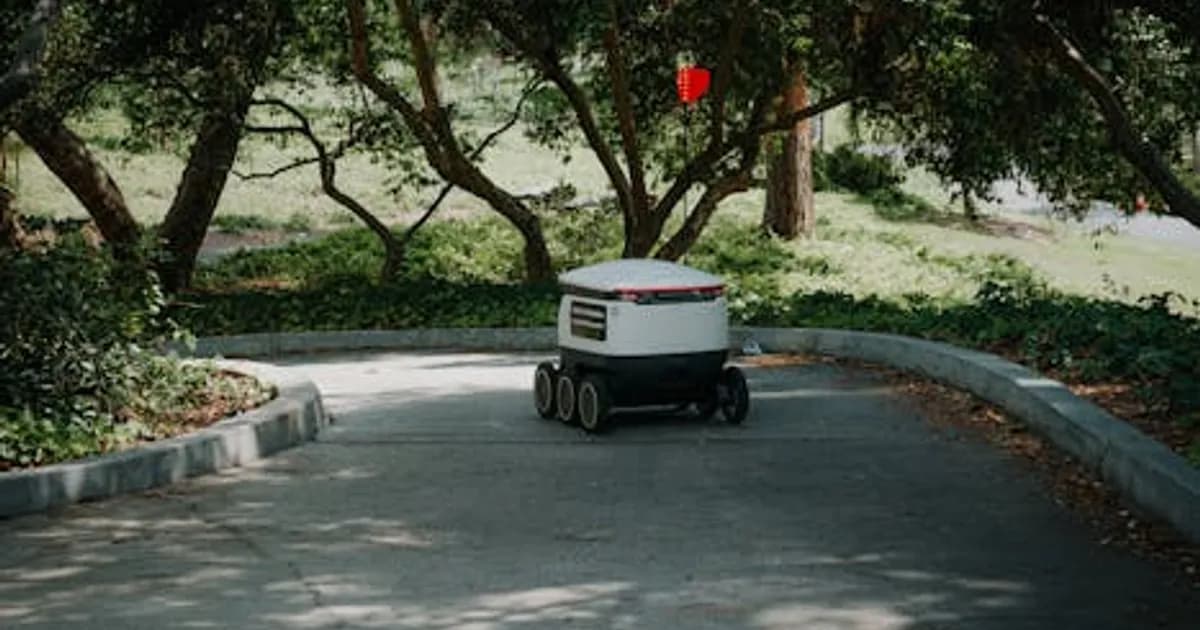
Autonomous delivery robots: Sidewalk robots from Starship Technologies and others are operational in specific geographies—university campuses and suburban residential areas with high delivery density. The economics work in specific environments; broad deployment remains several years out.
Drone delivery: Amazon Prime Air, Wing (Alphabet), and Zipline have commercial delivery operations in select markets. Regulatory progress in the US has been slower than the industry hoped; urban deployment at scale remains constrained by airspace management and noise concerns.
AI-Powered Freight Networks
Beyond last-mile, AI is reshaping freight movement at scale:
- Load matching: Digital freight platforms use AI to match available trucks with shipments, reducing empty miles—deadhead driving represents roughly 20-30% of truck miles in conventional freight operations
- Predictive fleet maintenance: AI monitoring of vehicle sensor data to predict maintenance needs before breakdowns occur on the road
- Port and intermodal operations: AI scheduling systems at container ports optimize crane operations, yard truck movements, and vessel scheduling
- Customs and trade compliance: AI document review for import/export documentation reduces processing time and error rates
Customer Experience Improvements
AI logistics also shows up in ways consumers directly experience:
- Delivery prediction accuracy: AI models that accurately predict delivery windows rather than giving broad four-hour estimates
- Proactive exception management: Systems that identify delayed shipments and automatically communicate with customers before they need to reach out to support
- Return optimization: AI systems that route returned items based on condition, restocking economics, and regional demand—improving the economics of reverse logistics
Customer satisfaction with logistics directly affects e-commerce conversion rates—shoppers remember failed deliveries and choose competitors accordingly.
Challenges Facing AI in Logistics
The challenges are real and shouldn't be minimized:
- Data integration: Logistics involves many handoffs between parties—shipper, carrier, 3PL, last-mile provider—each running different systems that don't communicate well
- Labor relations: Automation in warehouses has collided with organized labor in several high-profile cases; the social and political dimensions of warehouse robotics are not purely technical problems
- Returns complexity: Reverse logistics for e-commerce returns is structurally harder to automate than outbound fulfillment
- Real-world unpredictability: AI systems trained on historical patterns struggle with truly novel disruptions—extreme weather events, port strikes, or sudden demand spikes
What to Watch Through 2027
Developments worth tracking in AI logistics:
- Broader commercial drone delivery as regulatory frameworks mature in more markets
- More sophisticated AMR-human collaboration in mixed fulfillment environments where full automation isn't economical
- AI freight brokers that actively negotiate rates rather than just match loads
- Greater AI workflow automation integration connecting customer order systems directly with logistics execution platforms
For retailers and logistics operators in 2026, the question isn't whether to use AI—it's which capabilities to prioritize given budget and existing infrastructure. Route optimization and demand forecasting typically have the clearest ROI and the lowest implementation barrier for most organizations as starting points.
Comments
Loading comments...