
AI Robotics in Service Industries 2026: Hospitality and Retail
AI Robotics in Service Industries 2026: Hospitality and Retail
Robots have been promising to transform service industries for a decade. The promise has been repeatedly delayed — the complexity of unstructured human environments, the cost of capable hardware, and the social awkwardness of human-robot interaction all proved harder than projections suggested.
In 2026, the deployment picture has changed. Not because the hard problems are solved, but because they're solved well enough for a growing range of service tasks in specific environments.
What Changed Between 2023 and 2026
Three developments converged to accelerate service robot deployment:
Better manipulation and navigation. Robot dexterity and navigation in dynamic environments improved substantially. Robots that previously required carefully controlled, predictable environments can now handle more variability — avoiding humans who move unpredictably, recovering from minor failures, adapting to floor surfaces and lighting conditions that older systems couldn't handle.
Cheaper capable hardware. The cost of manipulator arms, sensors, and compute has fallen significantly. A capable service robot that would have cost $150,000 in 2021 can be purchased or leased for under $50,000 in 2026. For labor-intensive service industries with high turnover and rising wages, the economics have shifted.
Better AI for task learning. Foundation models applied to robotics — sometimes called Vision-Language-Action (VLA) models — enable robots to generalize from limited demonstrations to handle variations they weren't explicitly trained on. This reduces the deployment cost of adapting robots to new tasks and environments.
Hospitality: Where Deployment Is Most Advanced
Hotels have been among the most aggressive adopters of service robots, for practical reasons: the tasks are well-defined, the environments are semi-controlled, and the economics are favorable in high-labor-cost markets.
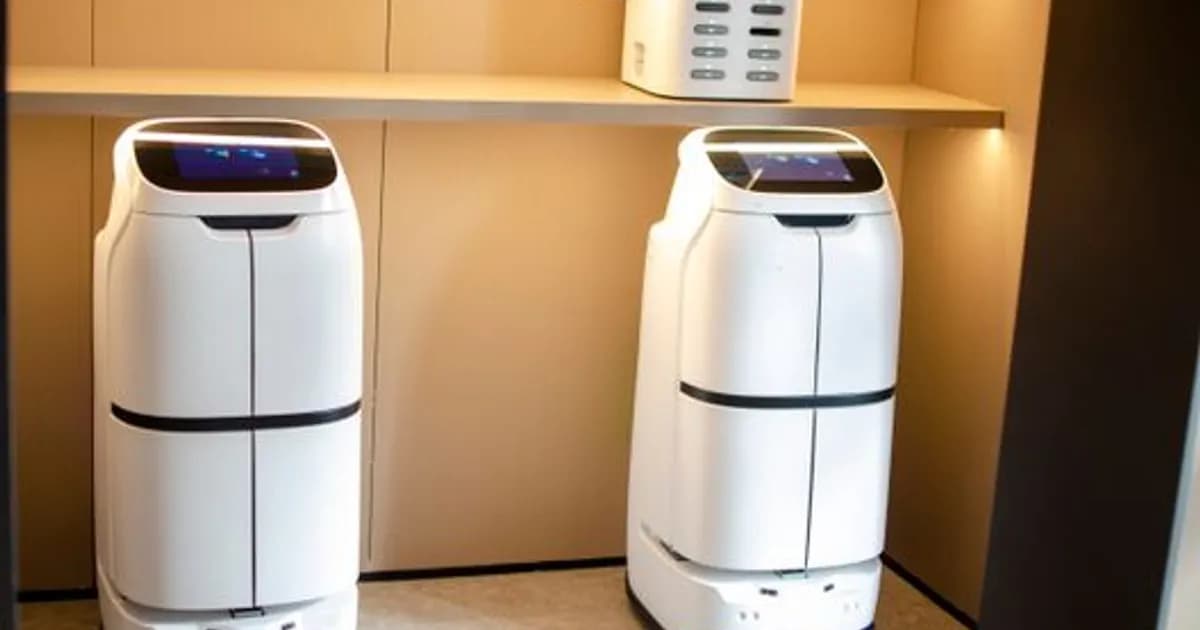
Room service delivery was the first major hotel robot application and remains the most common. Autonomous delivery robots operate elevators, navigate hallways, and deliver items to guest room doors. Savioke's Relay robot has been deployed in hundreds of hotels globally. Guest satisfaction with robot delivery is generally positive when presented as a novelty or convenience feature; mixed when guests prefer human interaction.
Housekeeping assistance robots handle high-labor tasks within rooms — stripping beds, collecting towels, vacuuming — while human housekeepers handle more complex and judgment-intensive tasks. Several major hotel chains including Hilton and Marriott have piloted and expanded housekeeping robot programs. The robots work alongside humans rather than replacing them; the productivity improvement comes from humans doing more rooms in less time.
Concierge and information kiosks with conversational AI handle common guest inquiries — directions, local recommendations, reservation status — without requiring staff engagement for routine questions. The AI quality has improved substantially; guests who engage with these systems for specific, answerable questions report satisfaction. Guests who try to have nuanced conversations or handle unusual situations still prefer human staff.
Front desk check-in automation using AI-powered kiosks has expanded, accelerated by contactless preferences established during the pandemic. Hilton, Marriott, and several boutique chains report high guest satisfaction with kiosk check-in for guests with simple needs; human staff remain essential for guests with complex situations.
Retail: Inventory, Logistics, and Customer-Facing Roles
Retail robotics deployment has followed a similar pattern: highest adoption for back-of-house logistics, growing but more cautious deployment for customer-facing applications.
Inventory scanning robots are the most widely deployed retail application globally. Robots that autonomously navigate store aisles scanning shelves to identify out-of-stock items, misplacements, and price tag errors are now deployed in thousands of locations. Walmart, Amazon-owned Whole Foods, and several major European retailers use these systems. They don't require complex manipulation — just navigation and vision — which makes them more reliable and affordable.
Warehouse and distribution center automation is mature and widespread, well beyond pilot status. Amazon Robotics operates millions of robot units across its fulfillment network. The humans in these facilities work alongside robots, handling tasks that require dexterity and judgment; robots handle the bulk movement and storage tasks. This isn't new in 2026, but the scale continues to expand.
Last-mile delivery robots are deployed at commercial scale in several cities. Starship Technologies operates autonomous delivery robots in university campuses and suburban neighborhoods across the US and Europe. Nuro has expanded its grocery and restaurant delivery operations in several markets. The technology works in the right environments; pedestrian infrastructure, regulations, and weather limit deployment geography.
Customer-facing retail robots — interacting with shoppers on the floor — have had more mixed results. Several high-profile pilots have ended or scaled back due to customer discomfort, robot navigation failures in crowded stores, or inability to handle the breadth of customer questions effectively. Robots that do specific, limited tasks (helping customers locate items in a large format store, for example) work better than general-purpose retail assistants.
The Labor Dynamics
Service robot deployment has become part of the broader conversation about automation and employment. The picture is more nuanced than either "robots are taking all the jobs" or "robots only create new jobs":
Direct displacement is real but limited. Jobs eliminated by service robots to date are concentrated in very specific, repetitive tasks within service roles. Room service delivery was typically handled by a human who did other things too; a delivery robot replaces the specific delivery trips but not the broader role.
Workforce restructuring is happening. Rather than mass layoffs, most hospitality and retail employers are reducing new hires and allowing natural attrition to reduce headcount in areas where robots operate. This is less visible than layoffs but has real employment effects for people who would have been hired into those roles.
Worker productivity and role changes. The most common near-term effect is that workers in robot-assisted environments handle more complex tasks and higher volumes. Hotel housekeepers assisted by robots service more rooms in a shift. Retail stock workers assisted by inventory robots spend less time counting and more time resolving issues the robot flagged.
Labor cost pressures as driver. Minimum wage increases and tight labor markets in many service industries have accelerated robot deployment by improving the economic case. At $15/hour minimum wage, a robot that costs $30,000 per year to lease and operate pays for itself faster than at $10/hour. This is explicitly driving adoption decisions at major chains.
See AI Agents Are Replacing Knowledge Work in 2026 for the broader perspective on AI's impact across job categories.
The Consumer Experience Reality
What do guests and customers actually experience? Honest assessment reveals a gap between marketing and reality:
Works well: Delivery robots, check-in kiosks for simple cases, inventory scanning robots (which customers don't directly interact with), order-taking tablets at quick service restaurants.
Works with friction: Interactive floor robots that try to have conversations, robots navigating crowded store environments during peak times, any application where customers want to handle an unusual situation.
Often disappoints: Robot baristas and food preparation robots in high-volume, high-variation environments; customer service applications where guests have complex needs; any situation requiring improvisation.
The most successful deployments have clear expectations — guests know they're using a self-service kiosk, not a robot pretending to be a person — and work within those expectations rather than claiming capabilities the system doesn't have.
Where This Is Heading
Service robotics in 2026 is at the early majority stage of adoption for well-defined applications and still in the early adopter stage for complex, interactive applications. The trajectory over the next five years:
Manipulation capability improvement will enable robots to handle more product handling, food preparation, and cleaning tasks reliably. These are larger job categories than delivery and represent the next significant wave of potential automation.
Cost continues to fall. Hardware prices will continue declining. Leasing models that eliminate capital expenditure will make deployment accessible to smaller operators.
Integration with AI models improves. Robots connected to better AI reasoning systems will handle more variation without failing. A robot that can recognize "this situation is outside my training and I should get a human" and execute that transition gracefully is more deployable than one that fails silently.
Regulatory and social norms solidify. Cities are developing clearer frameworks for sidewalk delivery robots, drone delivery, and robot operation in public spaces. As these frameworks clarify, deployment expands.
The science fiction vision of humanoid robots that do everything a human service worker does is still years away. The reality in 2026 is more modest and more useful: specific robots doing specific tasks in specific environments, reliably enough that the economics work for early-adopting operators.
That's not a disappointment. That's progress.
Comments
Loading comments...