
AI in Medical Imaging 2026: Faster, More Accurate Diagnosis
AI in Medical Imaging 2026: Faster, More Accurate Diagnosis
A radiologist reviewing chest CTs can realistically assess 50 to 70 scans in a day. An AI system can flag anomalies across thousands. That speed differential isn't replacing radiologists — it's changing what they spend their time on, which pathologies get caught early, and how quickly patients receive answers.
In 2026, AI medical imaging is one of the most mature clinical applications of artificial intelligence. The technology has moved well past proof-of-concept into routine clinical use at major health systems worldwide. Here's where things actually stand.
What AI Medical Imaging Does Today
Modern AI imaging tools don't just look for one thing in one type of scan. Multi-task models now flag multiple pathologies across a single image in a single pass. A chest X-ray AI might simultaneously screen for:
- Pulmonary nodules that could indicate early lung cancer
- Signs of pneumonia or COVID-related lung changes
- Cardiomegaly (enlarged heart)
- Pleural effusion (fluid around the lungs)
- Rib fractures
The same AI-first approach applies to mammography (breast cancer screening), brain MRI (stroke, tumors, white matter disease), retinal imaging (diabetic retinopathy, glaucoma), and bone X-rays (fractures, osteoporosis risk).
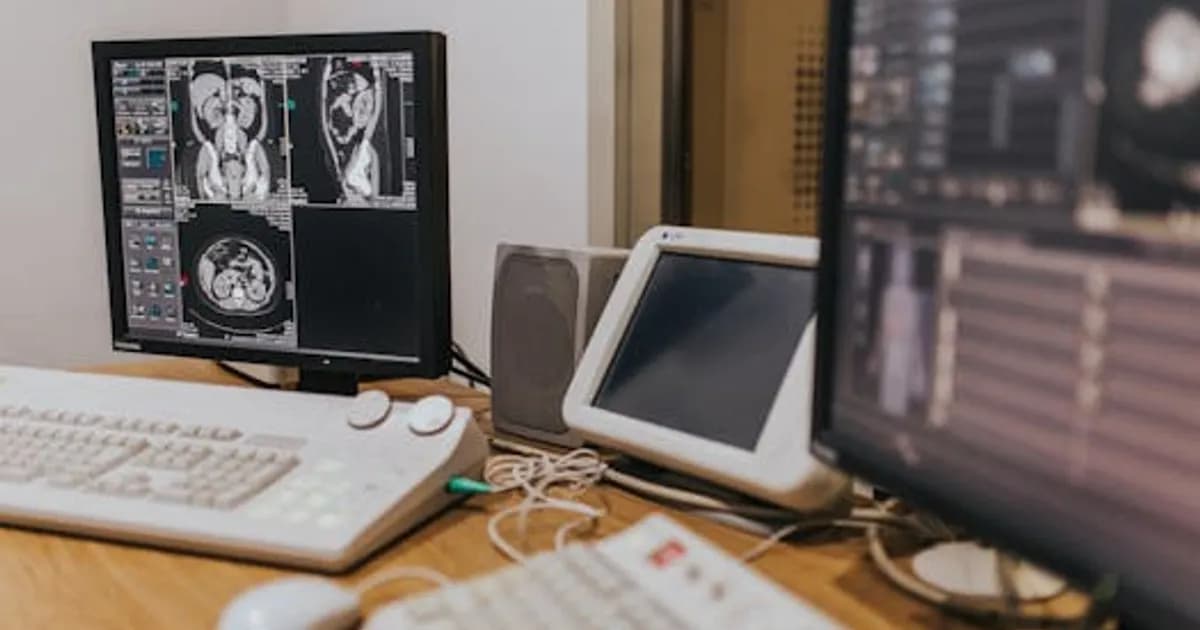
What's changed in 2026 compared to earlier years is that these systems are now embedded in clinical workflows rather than sitting as separate tools. Radiologists see AI annotations alongside the images in their reading software. They review, confirm, or override — the AI surfaces findings; the human makes the final call.
Accuracy: Where AI Outperforms and Where It Doesn't
The accuracy picture is nuanced. On specific, well-defined tasks with abundant training data, AI can match or exceed average radiologist performance. Diabetic retinopathy screening is the canonical example — FDA-cleared AI systems now operate with high enough accuracy in controlled settings to screen patients without a real-time physician review of each image.
For more complex or rare conditions, the picture changes. AI systems trained primarily on data from major academic medical centers in high-income countries underperform when deployed in other settings. A model that performs excellently on high-quality MRI images from a 3T scanner at a teaching hospital may struggle with images from older equipment in under-resourced facilities.
The FDA's database of AI/ML-enabled medical devices now lists over 900 cleared AI tools, the majority in radiology. That number reflects genuine clinical adoption, not just research. But clearance doesn't guarantee real-world performance matches what was tested in the approval study.
Studies in the New England Journal of Medicine and Radiology have also flagged the distribution shift problem: AI systems show performance drops when deployed in settings demographically different from their training data, and these drops aren't always caught in post-market surveillance.
The Workflow Impact on Radiologists
The question of how AI affects radiologist roles has evolved considerably. Early fears of wholesale replacement haven't materialized — AI has increased the speed and volume of reading, which has in some cases expanded demand for radiologists rather than reducing it.
What has changed is task composition. Routine screening reads — looking for obvious nodules or fractures — are handled faster with AI assist. Radiologists spend more of their time on:
- Complex multi-system findings that require synthesis
- AI flag review and overrides
- Communication with referring clinicians about findings
- Cases where the AI's confidence is low
Some radiologists report that AI assistance has reduced the cognitive fatigue of repetitive screening tasks, which is a meaningful quality-of-life improvement. Others raise concerns that over-reliance on AI flagging could erode pattern recognition skills developed through repetitive practice — a de-skilling risk that medical training programs are actively discussing.
AI in Stroke and Cardiac Emergency Imaging
Time sensitivity creates the clearest case for AI imaging in emergencies. In stroke care, every minute without treatment causes measurable brain damage. AI systems that automatically analyze CT perfusion images and identify salvageable tissue — and push those results to the on-call neurologist's phone before the patient has left the scanner — have become standard in major stroke centers.
Studies published in 2025-2026 show AI-assisted stroke triage reduces door-to-treatment times measurably. The tech works by removing the bottleneck of waiting for a radiologist to be physically present or available to review images remotely.
Cardiac AI applications are following a similar trajectory. AI analysis of echocardiograms can now detect heart failure with reduced ejection fraction, valve disease, and cardiomyopathies with accuracy comparable to board-certified cardiologists — and it does so in seconds rather than the 15-20 minutes a detailed manual review requires.
This directly connects to broader healthcare AI trends covered in AI in Healthcare 2026: Transforming Medical Diagnosis, where AI imaging is part of a larger diagnostic transformation.
Access and Equity in AI Diagnostics
AI medical imaging offers a genuine opportunity to extend specialist-level diagnostic quality to settings that lack specialists. A rural clinic with one general practitioner can use AI-powered retinal imaging to screen every diabetic patient for retinopathy — a condition that previously required an ophthalmologist's review and often wasn't caught until advanced.
This potential is real, but realizing it requires deliberate effort. The current commercial AI imaging market concentrates tools in large, well-funded health systems. Smaller hospitals and clinics in low-income countries face:
- High licensing costs relative to their budgets
- Limited technical infrastructure to integrate AI into workflows
- Training gaps that affect how well clinicians use and interpret AI outputs
- Regulatory uncertainty about locally validating foreign-cleared tools
The World Health Organization has called for equity-centered development of AI health tools, and some academic initiatives are building open-source imaging AI specifically for resource-limited settings. Progress is real but slow relative to the scale of need.
What's Coming: 3D, Longitudinal, and Foundation Models
The near-term direction of medical imaging AI points toward three advances:
3D volumetric analysis is becoming standard. Rather than analyzing 2D slices, AI processes the entire three-dimensional scan volume simultaneously, catching findings that manifest subtly across multiple planes.
Longitudinal comparison — comparing a patient's current scan against their own history — allows AI to detect changes too subtle to see in a single cross-sectional image. This is particularly relevant for tracking slow-growing tumors, assessing treatment response, and monitoring chronic lung disease.
Foundation models for radiology (large models pre-trained on millions of medical images across modalities) are showing strong performance on new tasks with limited fine-tuning data. This could dramatically accelerate deployment of high-quality AI for rare diseases and specialized imaging modalities that don't have enough data to train task-specific models from scratch.
For context on how AI is reshaping pharmaceutical discovery alongside diagnostics, AI Drug Discovery in 2026: How Pharma Is Using AI to Find Cures covers the parallel transformation happening in drug development.
The Bottom Line for Patients and Clinicians
AI medical imaging is working and improving. It catches things faster, reduces delays, and extends specialist-level screening to more patients. It also has real limitations — performance varies by setting, population, and image quality, and those variations aren't always visible to the clinicians using the tools.
The best current practice: AI as a collaborator that surfaces findings, not an autonomous decision-maker. The radiologist who stays in the loop, understands the AI's strengths and weaknesses in their specific patient population, and applies their own judgment is in the best position to deliver better outcomes.
If you're a clinician evaluating AI imaging tools, ask vendors for performance data on populations similar to yours — not just the headline accuracy numbers from the FDA clearance study.
Comments
Loading comments...