
AI in Dental Care 2026: Smarter Diagnostics and Treatment
AI in Dental Care 2026: Smarter Diagnostics and Treatment
AI in dental care has crossed from research papers into everyday clinical practice. Dentists across the country are using AI tools to catch decay that X-rays might miss, plan complex restorations more accurately, and manage patient workflows more efficiently.
Here's what's actually being used, what the evidence shows, and where the technology is headed.
How AI Is Entering the Dental Office
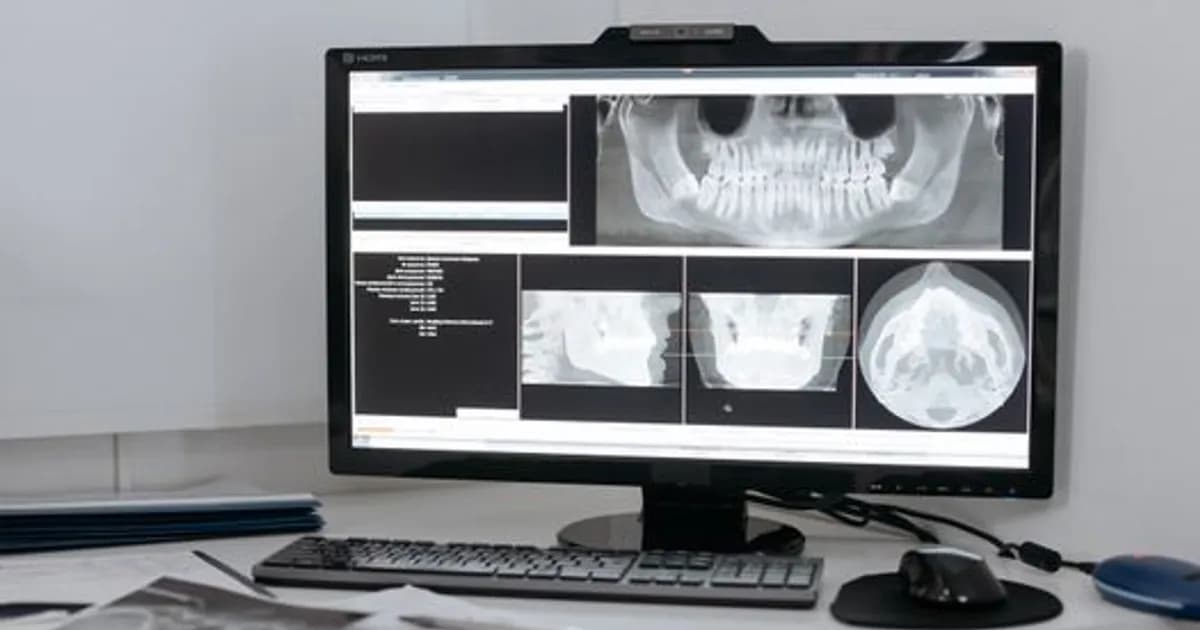
The entry point for AI in dentistry has been radiograph analysis — examining dental X-rays to identify decay, bone loss, and other conditions.
Human radiograph interpretation is good but imperfect. Studies have consistently shown that trained AI systems can match or exceed dentist performance on specific detection tasks, particularly for identifying early-stage interproximal decay (cavities between teeth) that can be easy to miss.
The business case for AI radiograph analysis tools is also straightforward. They catch more pathology per patient, which supports both better patient outcomes and legitimate increases in treatment planning. And they generate documentation that supports insurance claims.
Several factors have accelerated adoption in 2026:
- AI dental tools have received FDA clearance for clinical use, removing regulatory uncertainty
- Integration with major dental practice management software has improved significantly
- Pricing has dropped as competition among vendors increased
- Risk and liability arguments have shifted — the question is no longer "is AI safe enough?" but "what's the liability risk of not using available diagnostic aids?"
AI Dental Imaging: The Leading Tools
Several platforms have emerged as leaders in AI-assisted dental imaging.
Pearl is one of the most widely deployed AI dental imaging tools in the US. Its AI analyzes radiographs and highlights areas of concern — decay, bone loss, calculus, and other findings — as an overlay on the X-ray image. The dentist sees the AI's annotations and makes the final clinical judgment.
Overjet (now part of Carestream Dental) takes a similar approach, with AI that analyzes radiographs in real time as they're captured and provides quantitative bone level measurements alongside qualitative findings.
Dentsply Sirona's AI tools, integrated into their Carestream imaging platform, bring AI analysis directly into the imaging workflow used by a significant share of dental practices.
VideaHealth focuses specifically on using AI to standardize diagnostics across large dental group practices, where consistency of care across hundreds of locations is a meaningful challenge.
AI for Treatment Planning
Beyond diagnostics, AI is beginning to influence treatment planning — particularly for complex restorative and orthodontic cases.
Invisalign's ClinCheck software has long used computational modeling to plan clear aligner treatments. The AI component has become more sophisticated, with better simulation of tooth movement outcomes and identification of cases that might not be good candidates for clear aligners.
For implant planning, AI tools now analyze 3D CBCT scans and suggest implant placement positions that optimize for bone density, proximity to nerve structures, and prosthetic outcomes. Tools from Simplant and Nobel Biocare have integrated AI recommendations into their planning workflows.
In restorative dentistry, AI tools are beginning to help with crown design — analyzing the shape and bite relationship of adjacent and opposing teeth to suggest optimal restoration geometry. This reduces the number of adjustments needed at delivery.
Patient Risk Prediction With AI
One of the more underappreciated applications of AI in dentistry is predicting which patients are at high risk for future problems.
AI systems that analyze a patient's clinical history, radiograph findings over time, hygiene patterns, and systemic health factors can predict with meaningful accuracy which patients are likely to develop significant decay or periodontal disease before the next recall visit.
This shifts the practice's posture from reactive — treating problems when they appear — to proactive, allowing hygienists and dentists to prioritize educational interventions and more frequent recall intervals for high-risk patients.
Dental Intelligence and Sikka Software are two practice analytics platforms that have added predictive AI capabilities, flagging patients who are due for specific procedures or who show risk patterns based on their clinical data.
For related context on how AI is transforming healthcare diagnostics more broadly, AI in Medical Imaging 2026: Faster, More Accurate Diagnosis covers the hospital and radiology side of AI diagnostic tools.
AI for Dental Practice Management
The business side of running a dental practice — scheduling, billing, patient communication — is also benefiting from AI.
Automating recall and reactivation is the highest-impact application. AI systems analyze the patient database to identify patients overdue for recall, generate personalized outreach (text, email, or phone), and track engagement. Practices report significant improvements in schedule utilization without additional front desk effort.
Insurance claims processing has been a pain point in dentistry for decades. AI tools that analyze claim submissions, identify likely denial reasons before submission, and generate supporting documentation are reducing claim rejection rates.
Appointment scheduling optimization tools use AI to predict no-shows and cancellations and suggest double-booking strategies that maintain schedule density without regularly running late.
The integration between practice management platforms and AI tools has improved substantially in 2026. Dentrix, Eaglesoft, and Open Dental — the three dominant practice management platforms — all have established integration partners with AI analytics and communication tools.
Challenges and Limitations Worth Knowing
AI in dental care isn't without genuine challenges.
Training data quality matters significantly. AI systems trained primarily on radiographs from certain demographics or imaging equipment may perform less accurately in practices with different patient populations or equipment. Dentists should ask vendors about the diversity of their training datasets.
Over-reliance risk is real. When AI flags a finding, there's a natural tendency to treat it as confirmed. But AI tools have false positive rates. Dentists using these tools need to maintain their own diagnostic judgment rather than deferring entirely to AI outputs.
Patient communication is trickier than expected. When AI identifies findings and dentists present treatment plans based partly on AI analysis, some patients ask questions about the technology. Clear, confident communication about how AI serves as a diagnostic aid — not a replacement for clinical judgment — is necessary.
Cost and ROI varies by practice. For high-volume practices, the ROI on AI imaging tools is clear. For smaller practices with fewer patients, the math is less straightforward.
Where AI Dentistry Is Headed
The trajectory is toward more integration, more automation, and more preventive emphasis.
Expect AI tools to move further into full-mouth analysis — giving dentists a comprehensive AI-generated assessment of the entire oral cavity from a single imaging session. Expect better integration between dental and medical records, enabling AI to incorporate systemic health data into dental risk predictions.
Longer term, AI-guided robotics for certain dental procedures — currently in research stages — may begin limited clinical deployment.
AI tools in dental care are delivering real clinical value in 2026, not theoretical future promise. If you run a dental practice and haven't evaluated AI radiograph analysis tools, it's worth a serious look — both for diagnostic quality and for the documentation and workflow benefits. The adoption curve is steep, and the practices ahead of it are already seeing the advantages.
Comments
Loading comments...