
AI in Aviation 2026: How Airlines Are Using AI Right Now
AI in Aviation 2026: How Airlines Are Using AI Right Now
AI in aviation is no longer experimental. Airlines, air traffic control agencies, and airports are running production AI systems that affect millions of flights every day — optimizing routes, predicting maintenance failures, screening passengers, and personalizing travel experiences. The aviation industry has historically been slow and conservative with new technology for good reason, but AI has found its footing across the sector faster than most expected.
Here's where AI is actually deployed in commercial aviation in 2026, what it's doing, and what the limits still are.
Predictive Maintenance: The Highest-Stakes Application
Aircraft maintenance is where AI has delivered the most unambiguous value. Unscheduled maintenance events — unexpected failures that ground aircraft — are expensive and disruptive. Predictive maintenance AI analyzes sensor data from engines, hydraulic systems, landing gear, and avionics in real time, flagging components that show degradation patterns associated with upcoming failure before the failure happens.
Major aircraft manufacturers have embedded predictive analytics directly into their systems. Engine monitoring AI tracks thousands of data points per flight and compares readings against baseline performance, the aircraft's own historical data, and fleet-wide patterns from thousands of similar engines. Alerts go to maintenance crews before the aircraft lands, often with a specific recommendation — replace a specific sensor, inspect a hydraulic line, check a particular bearing.
The impact is measurable: airlines deploying mature predictive maintenance systems report meaningful reductions in unscheduled maintenance events and the associated delays and cancellations. The technology doesn't eliminate all unexpected failures, but it catches the predictable ones that previously only revealed themselves mid-flight.
Air Traffic Control Optimization
Air traffic control is a complex scheduling problem under constant pressure. AI tools are helping controllers manage increasing traffic volumes with better situational awareness and decision support.
Current AI applications in air traffic management include:
- Conflict detection: AI systems flag potential conflicts — two aircraft converging at the same altitude — earlier than traditional radar processing, giving controllers more time to respond
- Flow management: Predicting and managing bottlenecks at congested airports and en-route sectors to smooth traffic flow and reduce holding patterns
- Weather rerouting: Automatically generating alternative routing suggestions when convective weather blocks planned routes
- Runway optimization: Sequencing aircraft for landing approaches to minimize gaps and maximize throughput
The FAA's NextGen modernization program and Europe's Single European Sky initiative have both incorporated AI-assisted tools into controller workstations. These systems are advisory — a human controller makes every decision — but the quality and timeliness of the decision support has improved significantly.
IATA's aviation technology division at iata.org publishes regular industry benchmarks on where AI-assisted traffic management stands across global aviation systems.
Flight Operations and Fuel Efficiency
Fuel is the single largest operating cost for most airlines, and AI is attacking it from multiple angles.
Route optimization AI calculates the most fuel-efficient path through complex three-dimensional airspace, accounting for winds at different altitudes, traffic density, and weather in real time. The optimal route is often not the direct path. Airlines using continuous descent approaches — where aircraft descend smoothly from cruise altitude rather than in steps — report meaningful fuel savings per flight, and AI has made these approaches easier to execute consistently.
Turnaround optimization uses AI to coordinate the sequencing of ground operations — fueling, catering, cleaning, baggage, maintenance checks — so aircraft spend minimal time at the gate. Each minute of unnecessary gate time costs money and can cascade into delays.
Load optimization uses AI to balance weight distribution, manage standby lists, and optimize cargo and baggage handling to ensure efficient loading patterns.
The cumulative fuel savings from these AI applications across major airline fleets are significant — both financially and in terms of emissions reduction, which increasingly matters for regulatory and investor purposes.
Passenger Experience and Customer Service
AI in aviation is highly visible to passengers in a way that predictive maintenance is not.
AI-powered customer service handles rebooking, cancellation, baggage claims, and questions through chat and voice interfaces without human agent involvement for routine cases. Airlines have significantly expanded AI handling of disruption management — when a flight is cancelled, an AI system can automatically rebook affected passengers, issue vouchers, send notifications, and prioritize travelers with tight connections, all before a human agent is involved.
Personalization uses passenger history, seat preferences, meal choices, and upgrade patterns to tailor communications and offers. This is the same type of recommendation AI used in e-commerce applied to the specific needs of frequent flyers.
Security screening at several major airports now uses AI-assisted imaging to improve detection rates while reducing false positives that slow lines. Computer vision systems process CT scan images faster and more consistently than manual screening for certain threat categories.
Biometric boarding — facial recognition linked to passport databases — has rolled out at a growing number of airports globally, replacing physical document checks at several touchpoints. The AI that powers these systems is accurate enough for production use at scale, though the regulatory environment varies by country.
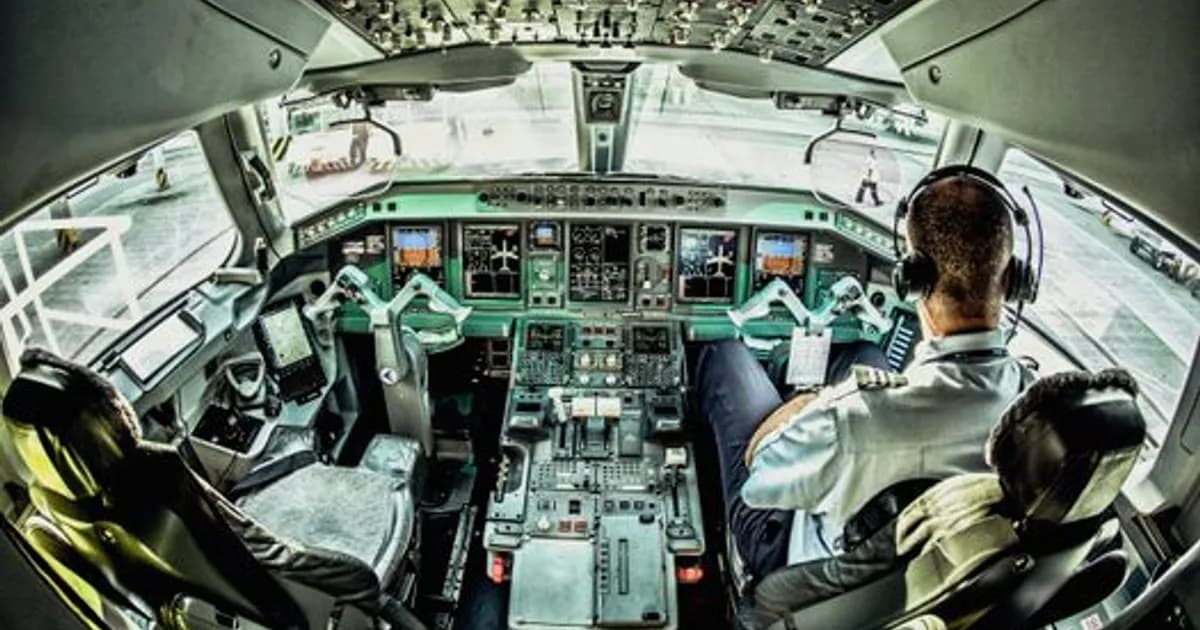
AI in the Cockpit: What's Actually There
The popular question about AI in the cockpit deserves a direct answer: autopilot systems have automated routine flight tasks for decades, but AI is extending those capabilities in specific areas.
Current cockpit AI applications include:
- Enhanced ground collision warning systems with AI that can distinguish between real terrain threat and false alerts more reliably
- Runway incursion detection that warns crews of potential conflicts with aircraft or vehicles on the runway
- Fatigue monitoring that uses facial analysis to detect signs of crew fatigue and alert when flight time limits are approaching
- Decision support for abnormal procedures — AI that cross-references checklist completion with system states
What AI in the cockpit does not include in 2026: autonomous flight without human crew, automated landing at uncontrolled airports, or AI-driven decision-making that overrides crew authority. The regulatory framework around crew authority and automation levels is explicit, and the industry isn't moving toward removing human oversight from flight operations.
For comparison, see how AI is handling autonomous vehicles on the ground in Self-Driving Cars in 2026: Where Autonomous Vehicle AI Stands — the aviation and automotive sectors have both made progress, but in very different regulatory environments.
The Challenges AI Hasn't Solved Yet
Aviation AI faces real limitations worth acknowledging.
Data interoperability remains a challenge across the fragmented aviation ecosystem. Airlines, airports, air navigation service providers, and manufacturers run different systems that don't share data easily. AI that could optimize across the full system often has to work with incomplete information.
Regulatory certification for AI systems is significantly more demanding in aviation than in other industries, and appropriately so. Proving that an AI system performs reliably across the full range of conditions it might encounter — including rare and adversarial inputs — takes time. This is a genuine constraint on how quickly AI can be deployed in safety-critical cockpit applications.
Explainability matters more in aviation than in most other AI applications. When an AI makes a recommendation, maintenance engineers and controllers often need to understand why, not just accept the output. Black-box AI struggles to meet this standard and is less prevalent in aviation than interpretable, rule-based AI systems.
The FAA's AI regulatory framework at faa.gov provides the formal structure within which aviation AI must operate — and it's worth reading if you want to understand why aviation AI adoption looks different from AI adoption in less regulated industries.
What's Next for Aviation AI
The near-term priorities in aviation AI are extensions of what's already working: better predictive maintenance coverage, more integrated traffic management, and wider deployment of biometric and customer-service automation.
Longer-term, the aviation industry is watching autonomous air cargo closely. Cargo operations have more permissive regulatory frameworks than passenger operations, and several companies are running autonomous cargo flights in controlled airspace. The lessons from autonomous cargo are expected to inform the eventual framework for autonomous commercial operations, though that remains years away in any meaningful scale.
The Bottom Line
AI in aviation in 2026 is real, deployed, and producing measurable results in maintenance, operations, and customer service. The industry's conservative, safety-focused culture has meant AI is rolling out where it can be validated and controlled, not everywhere at once.
For travelers, most of the AI in aviation is invisible — it's working in systems you never interact with directly. That's appropriate. The most important AI in aviation is the kind you never notice because everything went as planned.
The next decade will determine how far autonomous operations extend in aviation. For now, AI is making the existing system significantly better without replacing the humans responsible for safety-critical decisions.
Comments
Loading comments...