
AI Autonomous Science in 2026: Research Agents Run Experiments
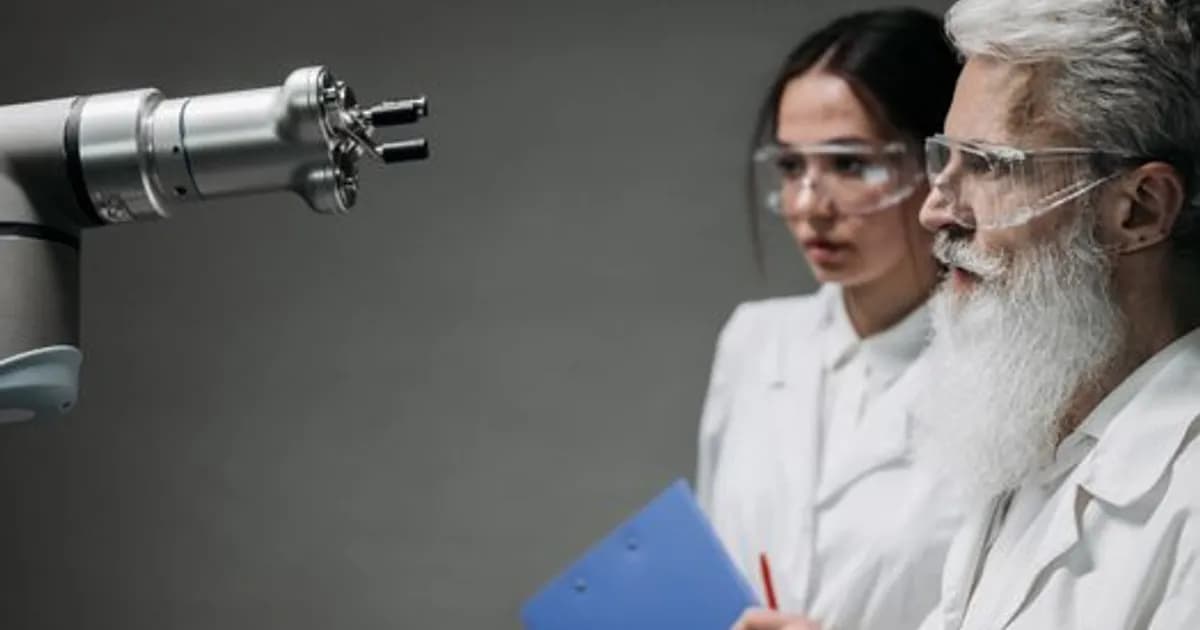
AI Autonomous Science in 2026: Research Agents Run Experiments
Science has always moved fast by human standards, and painfully slow by the standards of what's actually possible. In 2026, AI autonomous science agents are compressing timelines that once took years into weeks — running experimental cycles, generating hypotheses, and interpreting results with minimal human direction.
This is not science fiction. Several research institutions and biotech companies have now deployed AI systems that operate laboratory equipment, analyze results, and generate the next round of experiments automatically.
What Autonomous Science Agents Actually Do
A modern AI science agent isn't just a chatbot that answers questions about research. It's a system that:
- Generates hypotheses from literature review and prior experimental data
- Designs experimental protocols to test those hypotheses
- Interfaces with robotic laboratory equipment to execute experiments
- Analyzes results and updates its model of the problem
- Decides what to test next based on information gain
The loop closes without human intervention at each step. Researchers set the problem, define constraints and safety bounds, and review outputs — but the iterative cycle runs on its own.
Carnegie Mellon's AI research labs reported in July 2026 that their autonomous chemistry agent completed 847 experimental cycles in the time a human team would have completed roughly 60. Most runs were exploratory and yielded negative results — which is expected and valuable. The positive hits were richer for the context of all the failed approaches the system had already ruled out.
The Companies Driving This Field
Several companies and institutions are at the leading edge of AI autonomous science:
Recursion Pharmaceuticals uses AI agents to run phenotypic drug screens. Their systems test thousands of compound-cell combinations daily and identify candidate molecules that would take human researchers years to find manually. Recursion's pipeline now includes dozens of AI-discovered drug candidates in preclinical development.
Insilico Medicine runs end-to-end AI-designed drug discovery campaigns. Their AI system identified and designed a novel fibrosis drug candidate that entered Phase 2 clinical trials — the first AI-generated small molecule to reach that stage.
DeepMind's GNoME continues to operate as one of the largest AI-driven materials discovery systems. Since its 2023 launch, it has predicted over 2.2 million new stable crystal structures, thousands of which have been validated experimentally.
For a look at how AI is accelerating drug discovery more broadly, see AI Drug Discovery in 2026.
The Role of Robotics
AI science agents don't work alone — they depend on robotic laboratory infrastructure to physically execute experiments. Self-driving labs combine:
- Liquid-handling robots that prepare samples and run assays
- Automated imaging and spectroscopy systems
- Real-time data pipelines that feed results back to the AI
- Environmental controls managed by software
The Acceleration Consortium at the University of Toronto operates one of the world's first fully self-driving labs. Funded by a major Canadian government initiative, it runs continuous chemistry and materials discovery campaigns with AI directing all experimental decisions.
The bottleneck is no longer computational — it's physical throughput. More robotic capacity means more experiments per day. Several biotech startups are now selling "autonomous lab-as-a-service" offerings where customers specify a discovery problem and the infrastructure runs continuously until it finds candidates.
What This Means for Traditional Research
The implications for how science is conducted are significant and somewhat uncomfortable for existing institutions.
Publication pressure changes. When a system runs thousands of experiments, selecting which results to publish becomes a different problem. The incentive to selectively report positive findings — a known issue in traditional research — interacts poorly with autonomous systems that can generate huge volumes of results.
Researcher roles shift. Scientists are moving toward problem formulation, safety oversight, and interpretation — away from hands-on experimental execution. This requires different skills and raises questions about how scientific judgment develops when fewer researchers are physically running experiments.
IP and attribution get complicated. When an AI system invents a novel compound or material, questions of inventorship become legally contested. Several patent disputes involving AI-generated discoveries are currently active in US and European courts.
Reproducibility improves. Automated systems with full audit trails tend to produce more reproducible results than human-run experiments where protocol variations are common. This is a meaningful improvement for scientific reliability.
Where AI Science Agents Fall Short
Autonomous science agents are impressive in well-structured domains — chemistry, materials science, protein folding, drug screening — where experiments are measurable, repeatable, and can be automated with existing robotics.
They struggle significantly in:
- Open-ended biological systems where the right question isn't obvious
- Social science and behavioral research where human subjects and complex variables resist automation
- Theoretical work that requires insight and conceptual leaps rather than systematic search
- Cross-domain problems where expertise from multiple fields needs to be genuinely integrated rather than retrieved
The AI science agent is a powerful tool for systematic search through well-defined hypothesis spaces. It doesn't replace the creative and conceptual dimensions of science that determine which problems are worth exploring in the first place.
The Funding Landscape
Venture capital investment in AI-driven drug discovery and autonomous lab technology has accelerated sharply in 2026. CB Insights tracking shows over $4.2 billion invested in AI-driven scientific discovery companies through Q2 2026, with biotech and materials science representing the largest shares.
Government investment is also significant. The US CHIPS and Science Act provisions for AI research infrastructure have channeled substantial funding into national laboratory AI integration programs. Similar investments are underway in the UK, EU, and China.
Research universities are adapting — some faster than others. Institutions with strong biomedical engineering and computer science programs have moved quickly to integrate autonomous lab infrastructure. More traditional institutions are moving cautiously, uncertain how autonomous systems interact with grant-based research culture.
Looking Ahead
By the end of 2026, autonomous science systems are expected to be running continuously at dozens of pharmaceutical companies, national laboratories, and academic research institutions. The technology is proven; the scaling question is now one of infrastructure investment and institutional adoption.
The bigger open question is whether AI science agents will begin to identify research directions that humans would not have considered — not just executing hypotheses faster, but generating fundamentally novel approaches. Early evidence suggests this is beginning to happen in narrow domains. The broader version of that capability, if it arrives, would represent a qualitative change in how scientific knowledge grows.
For now, the conservative description is still the right one: AI autonomous science agents are making systematic scientific search dramatically faster. That alone is enough to change what's possible in drug discovery, materials science, and climate research within the next decade.
The lab bench is getting smarter — and less crowded.
Comments
Loading comments...