
AI in Manufacturing 2026: Smart Factories Take Over
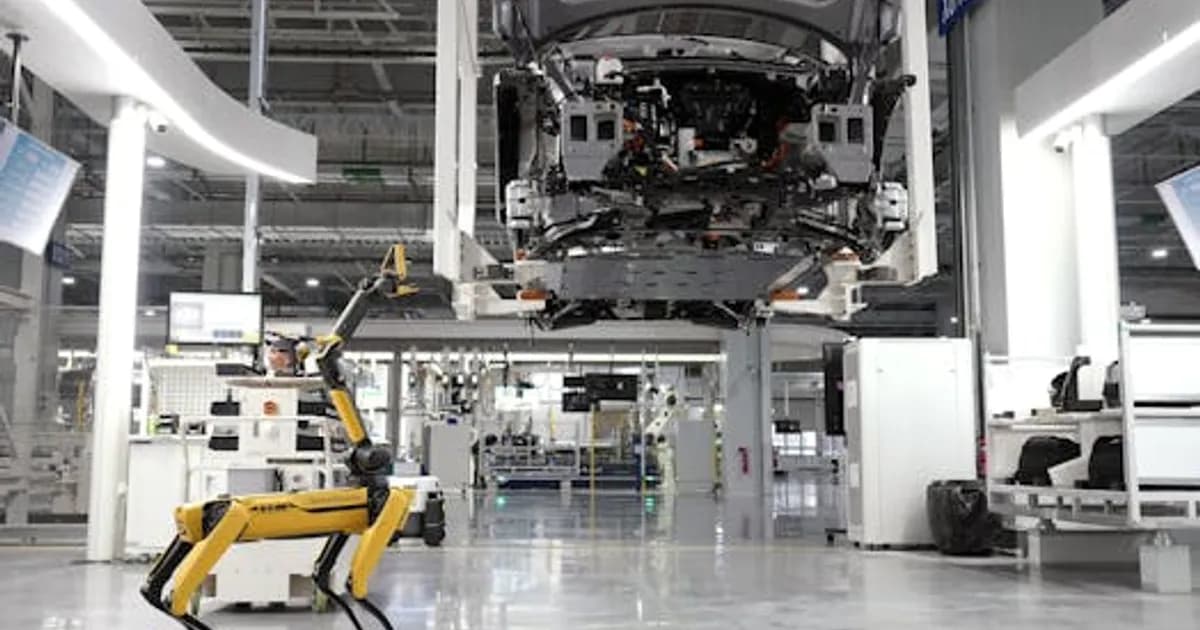
AI in Manufacturing 2026: Smart Factories Take Over
AI in manufacturing has moved well past the proof-of-concept stage. In 2026, industrial AI is driving measurable outcomes in factories across automotive, electronics, aerospace, consumer goods, and heavy industry. The question has shifted from "should we adopt AI in manufacturing?" to "how fast can we scale what's already working?"
This piece covers the highest-impact applications, where the ROI evidence is strongest, and what manufacturers still need to work through.
Why 2026 Is a Turning Point for Industrial AI
Several forces converged to make 2026 a critical year for AI in manufacturing. First, sensor costs have dropped dramatically over the past five years — it's now economically viable to instrument every machine, conveyor, and assembly station in a facility. The data that AI needs to function has become cheap to collect.
Second, foundation models trained on broad industrial data have reduced the time and cost of customization. Previously, deploying predictive maintenance AI required months of facility-specific training on local data. In 2026, pre-trained industrial models fine-tune to a specific facility's patterns in days or weeks, dramatically lowering the implementation barrier for mid-size manufacturers who can't fund multi-year AI projects.
Third, the labor market has pushed manufacturers toward automation more urgently than most forecasts predicted. Skilled manufacturing labor shortages in most developed economies have made AI-assisted operations not just attractive but operationally necessary for maintaining output levels.
Predictive Maintenance: The Strongest ROI Case
Predictive maintenance is where the clearest return-on-investment evidence lives in AI in manufacturing. The premise is straightforward: sensor data from equipment — vibration signatures, temperature profiles, acoustic patterns, power draw — is continuously analyzed to detect patterns that precede failures. Maintenance can then be scheduled before a breakdown occurs rather than in response to one.
The cost difference is significant. Unplanned downtime in manufacturing can cost anywhere from $17,000 to over $100,000 per hour depending on the facility and product type. Well-implemented predictive maintenance AI reduces unplanned downtime by 30–50% at facilities that have deployed it comprehensively.
Beyond avoiding failures, predictive maintenance extends asset lifetimes by enabling condition-based maintenance rather than calendar-based maintenance. Equipment gets serviced when it actually needs it, not on an arbitrary schedule that often leads to either over-maintenance (costly) or under-maintenance (risky).
Leading vendors in this space — Siemens, Honeywell, GE Vernova, and newer entrants like Augury and Samsara — have accumulated enough cross-facility data to offer genuinely pre-trained models for specific equipment categories. A paper mill implementing predictive AI for press rolls in 2026 doesn't have to start from scratch.
AI-Powered Quality Control on the Factory Floor
Visual quality inspection was one of the first AI in manufacturing applications to reach widespread deployment, and in 2026 it has become the default approach at high-volume production facilities.
AI vision systems detect surface defects, dimensional variations, assembly errors, and contamination at speeds and consistency that human inspectors can't match on high-speed lines. At modern production rates, human visual inspection isn't viable — line speeds exceed what the human visual system can reliably evaluate without fatigue-related error accumulation.
More recent developments go beyond simple defect detection. AI quality control systems in 2026 are increasingly capable of root-cause analysis — not just flagging defects, but correlating them with upstream process parameters to identify what's causing them. A surface defect in an automotive panel might be traced to a temperature fluctuation in the stamping press that occurred several steps earlier. That closed-loop feedback is where quality AI starts to generate compound benefits beyond basic inspection.
Accuracy rates at mature deployments are striking. Several electronics manufacturers report AI inspection systems achieving defect detection above 99.9%, with false-positive rates low enough that they don't significantly disrupt line flow.
Collaborative Robots and the Human Workforce
Collaborative robots (cobots) have been part of factory floors for years, but AI in manufacturing has significantly changed what they can handle in 2026. Earlier cobots operated on fixed programs and required precise, consistent inputs. AI-enabled cobots can adapt to variation — slightly different component orientations, changing line conditions, different product configurations on mixed production runs.
This matters because real factories are messy. Parts aren't always perfectly aligned. Products change frequently. Human-robot collaboration has expanded from structured, predictable tasks to more variable operations — kitting, pick-and-place with irregular objects, assembly operations where exact component position varies batch to batch.
AI robotics companies including Boston Dynamics, Apptronik, and Agility Robotics are pushing humanoid platforms into manufacturing environments, though broad deployment of humanoid robots in manufacturing is largely a 2027–2028 story for most facilities. The current state of AI robotics in 2026 provides more detail on where the technology actually stands.
The workforce impact has been more nuanced than either optimistic or pessimistic predictions. AI in manufacturing has reduced headcount in specific roles — repetitive visual inspection, data entry, and simple assembly — while increasing demand for technicians who maintain, calibrate, and supervise AI systems. Net employment impact varies by facility type and region.
Supply Chain Intelligence in 2026
Beyond the factory floor, AI in manufacturing has extended into supply chain optimization with notable results. Demand forecasting, inventory optimization, and logistics routing were early applications that have now matured into sophisticated systems with real track records.
Manufacturers dealing with volatile material costs and supply chain disruptions — still a feature of the operating environment in 2026 — are using AI to model risk scenarios and maintain resilient sourcing strategies. AI systems can monitor supplier performance indicators, commodity markets, geopolitical signals, and logistics bottlenecks simultaneously, triggering procurement decisions or risk alerts faster than human supply chain managers can.
The cost savings AI is delivering to businesses in 2026 are particularly visible in manufacturing supply chains, where the combination of predictive procurement and optimized inventory can free up significant working capital.
The Challenges That Remain
AI in manufacturing is delivering results, but several genuine challenges persist:
- Legacy equipment integration: A large share of manufacturing assets are not instrumented and weren't designed to interface with modern AI systems. Retrofitting is possible but costly, and the business case isn't always clear for older equipment with limited remaining life
- Data quality and governance: AI is only as good as the data it trains on, and many factories have years of poorly labeled, inconsistently collected historical records that require significant cleanup before they're useful
- Cybersecurity exposure: Connected factory systems expand the attack surface meaningfully — an AI-enabled facility has far more networked endpoints than a traditional one
- Skills gap: There aren't enough industrial AI specialists who understand both data science and manufacturing processes to staff every facility that wants to move quickly
- Change management: Operators who've worked the same process for years are sometimes resistant to AI-generated recommendations that contradict their experience, even when the AI is correct — this is a human and organizational challenge more than a technical one
What the Next Phase Looks Like
The near-term milestone most industry observers are watching is the fully autonomous production shift — a facility running a complete production cycle with AI managing quality, equipment, scheduling, and exception handling without human operators present. A few facilities are running partial versions of this today.
Between now and then, the competitive advantage in manufacturing goes to organizations building the data infrastructure and operational knowledge to scale AI effectively — not just piloting individual applications in isolation. The companies that have spent the past two years connecting their data, standardizing their processes, and training their workforces are moving into a sustained lead that will be difficult for late starters to close quickly.
AI in manufacturing is not a technology project. It's an operational transformation that uses technology as its primary lever.
Comments
Loading comments...