
Fine-Tuning vs Prompt Engineering for Small Projects
Fine-Tuning vs Prompt Engineering for Small Projects
If you've spent any time integrating AI into a small project — an OpenCart store, a client site, a side tool — you've probably hit this question: should I fine-tune a model, or just get better at writing prompts?
The answer matters because one path costs significantly more time and money than the other. And for most small projects, the choice is clearer than the AI marketing noise suggests.
What Prompt Engineering Actually Is
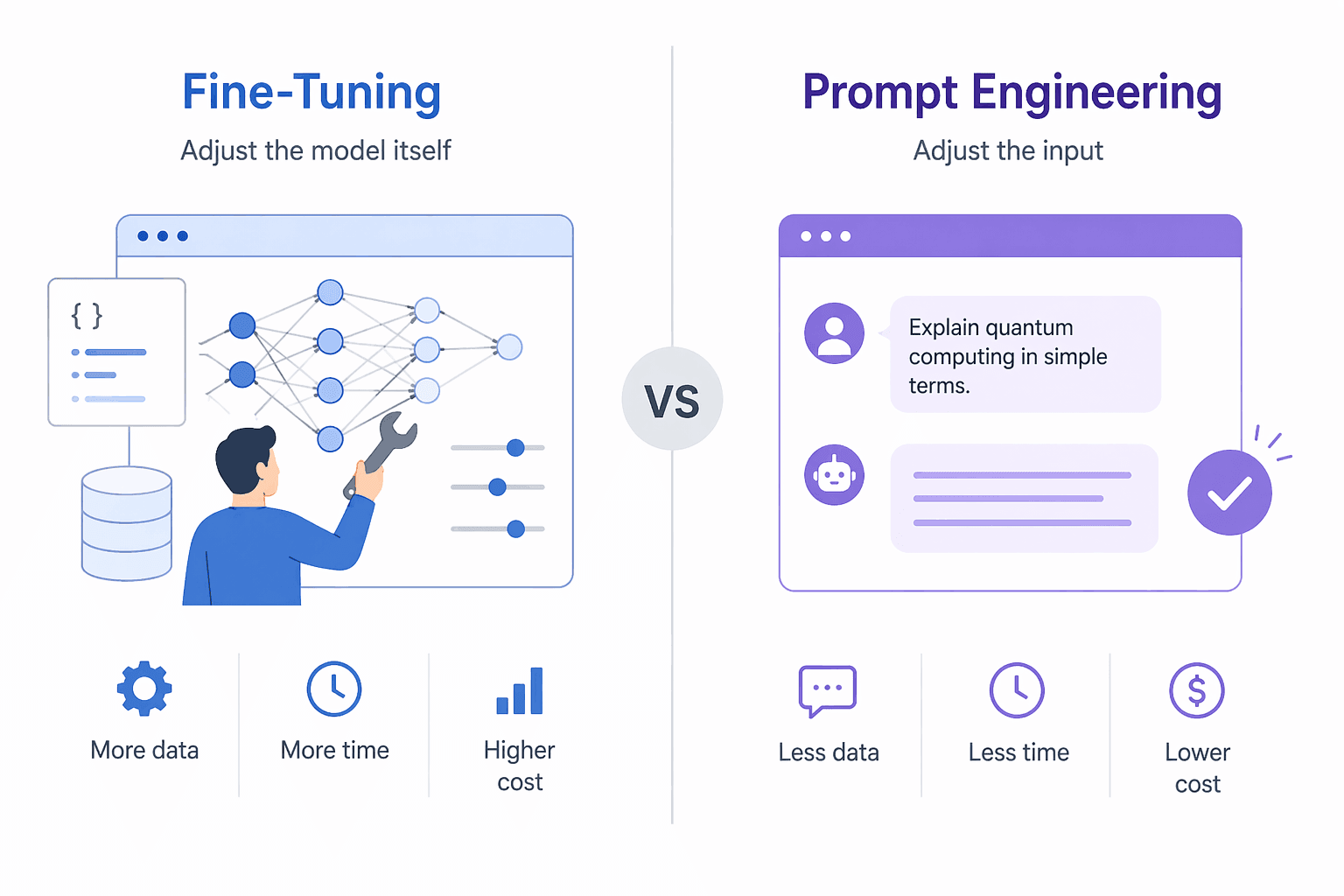
Prompt engineering is the practice of crafting your inputs — the instructions, context, and examples you send to a model — to get consistently good outputs without changing the model itself.
This includes everything from basic instruction phrasing to advanced prompt engineering techniques like few-shot prompting (providing example input-output pairs), chain-of-thought reasoning (asking the model to reason step by step), and system prompt design (setting a persistent persona or ruleset).
The model stays the same. You're just learning to speak its language well.
What Fine-Tuning Actually Is
Fine-tuning is a process where you take a pre-trained model and continue training it on your own dataset. The model's weights change. It learns patterns specific to your data.
OpenAI fine-tuning, for example, lets you upload hundreds or thousands of example completions in a structured JSONL format. The API then trains a custom model variant you can call just like the base model — but it responds differently based on what it learned from your examples.
It sounds powerful. It can be. But it comes with real costs:
- Data preparation — you need clean, labeled training examples (typically 50–500+ for meaningful results)
- Training cost — billed per token processed during training
- Inference cost — fine-tuned models often cost more per call than base models
- Iteration time — a training run takes time, and you may need multiple rounds
- Maintenance — if the base model is updated, you may need to re-fine-tune
Where the Confusion Comes From
Fine-tuning sounds like AI model customization at the deepest level, and technically it is. That makes it seem like the "serious" option — the one real developers use.
But that framing is misleading. Fine-tuning was designed for cases where prompting genuinely cannot solve the problem. It was not designed to be the default.
The OpenAI fine-tuning documentation itself recommends exhausting prompt engineering before considering fine-tuning.
Most developers who jump straight to fine-tuning do so because they wrote a mediocre prompt, got mediocre results, and assumed the model needed retraining. In many cases, a better prompt would have solved it.
Fine-Tuning vs Prompt Engineering: A Decision Framework
Here's a straightforward way to think about it.
Start with prompt engineering if:
- You're in early development or validating an idea
- Your use case involves general language tasks (summarizing, classifying, rewriting, Q&A)
- You have fewer than a few hundred high-quality labeled examples
- Your budget for AI API calls is limited
- You need to iterate quickly
Consider fine-tuning only if:
- Prompt engineering has genuinely failed after serious effort — not after one attempt
- You need a very specific output format or style that prompts consistently get wrong
- You're making thousands of API calls per day and a shorter prompt would meaningfully reduce costs
- You have a proprietary domain with terminology, tone, or structure that a general model handles poorly
- You have the labeled data and the time to prepare it properly
For a small business AI use case — an OpenCart store generating product descriptions, a support bot answering FAQs, a tool that classifies incoming orders — prompt engineering handles the overwhelming majority of scenarios.
What Good Prompt Engineering Actually Looks Like
A lot of developers dismiss prompt engineering because they've only tried simple prompts. Real prompt engineering is closer to software design than it is to casual chatting.
A production-grade prompt for, say, an e-commerce description generator might include:
- A system prompt that defines tone, format, word count range, and what to avoid
- A few-shot section with two or three example product-description pairs
- A structured input template that injects product attributes consistently
- An explicit output format instruction (e.g., "Return only the description, no preamble")
That kind of prompt engineering takes an afternoon to build properly. It can produce results that are remarkably consistent across hundreds of products — without a single model weight changing.
If that still isn't working, then fine-tuning becomes worth considering. But in practice, most small project builders never reach that ceiling.
The Cost Reality
As of early 2026 (verify current pricing before committing), OpenAI fine-tuning for GPT-4o costs roughly $25 per million tokens for training, plus higher inference costs than the base model. For a small project generating a few thousand completions a month, a well-written prompt sent to the base model is almost always cheaper in total.
Fine-tuning makes economic sense at scale — when the shorter context window a fine-tuned model needs translates to real token savings across millions of calls. That's not the situation most small business AI builders are in.
Start with Prompts. Fine-Tune Later If You Need To.
For developers and store owners working on small projects: start with prompt engineering. Build a system prompt. Add few-shot examples. Test with real inputs. Iterate.
The fine-tuning vs prompt engineering debate is largely settled for small projects — not because fine-tuning is bad, but because it's a tool built for a different scale of problem. Reaching for it too early wastes time, money, and focus that would be better spent on the product itself.
Get your prompts right first. Fine-tune later, if you ever need to.
Frequently Asked Questions
Does fine-tuning make the model smarter or more knowledgeable? No. Fine-tuning adjusts how a model responds, not what it knows. It can't add new factual knowledge. For knowledge-intensive tasks, retrieval-augmented generation (RAG) is a better tool.
How many examples do I need to fine-tune effectively? OpenAI recommends starting with 50–100 examples for initial results, with quality mattering more than quantity. Noisy or inconsistent examples actively hurt performance.
Can I combine prompt engineering and fine-tuning? Yes. Fine-tuned models still accept system prompts and instructions. In practice, fine-tuning handles style and format consistency while the prompt handles task-specific context.
Is few-shot prompting the same as fine-tuning? No. Few-shot prompting shows the model examples within the prompt at inference time. Fine-tuning bakes the learning into the model's weights permanently. Few-shot is faster to test and free to iterate.
When does prompt engineering stop being enough? When you've built a well-structured prompt with good few-shot examples and the model is still producing outputs that require significant correction at a rate that affects your workflow — that's the signal to evaluate fine-tuning seriously.
Comments
Loading comments...