
AI Warehouse Robotics in 2026: Picking, Packing, Speed
AI Warehouse Robotics in 2026: Picking, Packing, Speed
AI warehouse robotics has moved past the pilot stage. In 2026, robots that pick individual items off shelves, pack irregular orders, and navigate crowded aisles alongside human workers are running in production at scale — not just in flagship Amazon facilities, but in mid-size third-party logistics warehouses serving ordinary retailers.
The shift that mattered most wasn't a single breakthrough robot. It was AI models finally getting good enough at the unglamorous task that broke every previous generation of warehouse automation: picking up an object it has never seen before, in a bin full of other objects, without crushing, dropping, or misidentifying it.
Why Picking Was the Hard Part
Moving pallets around a warehouse has been automated for decades. Conveyor belts, automated guided vehicles, and sorting systems are mature technology. The bottleneck was always the last few feet — getting a single SKU out of a bin and into a box.
Human pickers handle this effortlessly because they can recognize an item, judge its fragility, and adjust their grip on the fly. Robots struggled because warehouse inventory is enormous and constantly changing. A robot arm trained to recognize 10,000 SKUs is useless the day a retailer adds a new product line.
Vision-language models changed that calculus. Instead of training a robot on a fixed catalog, AI picking systems now use general-purpose visual understanding combined with depth sensing to identify, grasp, and place objects they've never explicitly been trained on. Picking accuracy for novel items has gone from a curiosity in research papers to a metric warehouse operators actually track in production.
The shift also changed how quickly a facility can onboard a new client or product line. Under the old approach, adding a new retailer's catalog to a fulfillment center meant weeks of labeling, training, and validation before robots could handle it reliably. With general-purpose visual grasping, a new SKU often needs little more than a quick photo reference and a handful of test picks before it's added to active rotation — a difference that matters enormously to third-party logistics providers juggling dozens of client catalogs that change constantly.
What's Actually Deployed in 2026
A handful of capabilities are now common across major fulfillment operations:
- Item-agnostic picking arms that grasp a wide range of shapes and materials using suction, soft grippers, or multi-finger hands, switching grip strategy based on real-time visual assessment
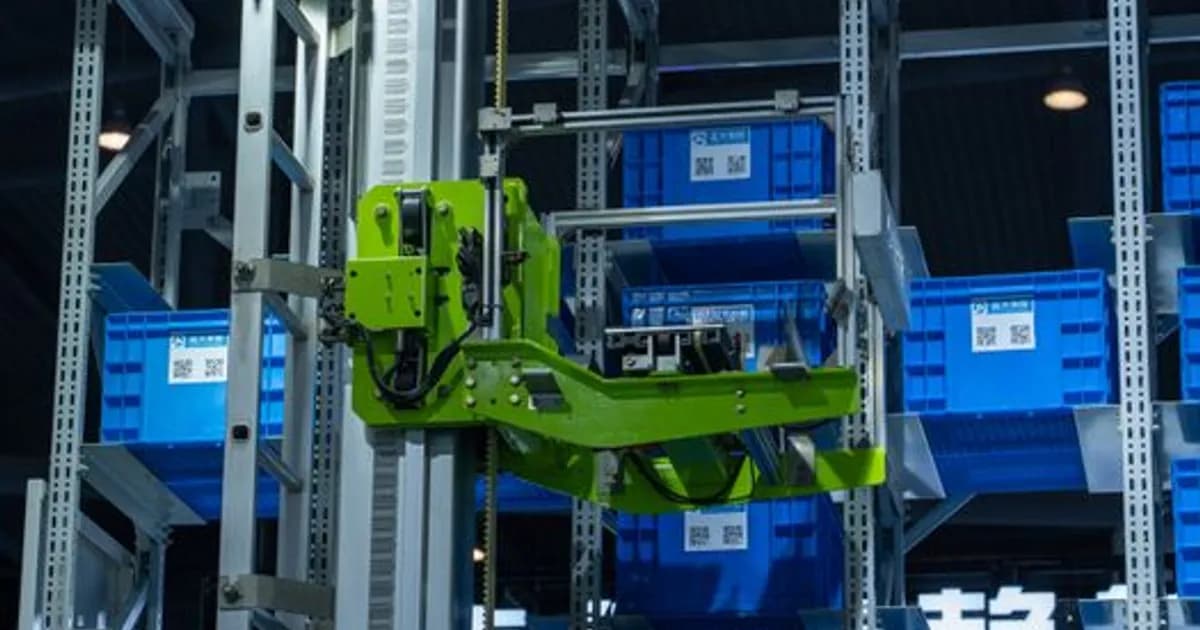
- Mobile fulfillment robots that bring shelving units to stationary human pickers, cutting walking time, which has historically eaten up a large share of a warehouse worker's shift
- Collaborative pack stations where a robot arm assembles outbound boxes while a human handles exceptions and quality checks
- AI-driven slotting that continuously reorganizes where inventory sits based on predicted demand, so fast-moving items end up closer to pack stations
None of these replace the warehouse workforce outright. Most facilities running advanced robotics still employ similar headcounts to before — the work has shifted from walking and lifting toward supervising, restocking robot bins, and handling the exceptions robots can't resolve.
Training Robots Faster With Simulation
One reason picking systems improved so quickly is that training no longer happens primarily on physical hardware. Robotics teams now train grasping models almost entirely in simulated warehouse environments, generating millions of synthetic picking attempts against virtual replicas of real product catalogs before a robot arm ever touches a physical item.
This matters because physical trial-and-error is slow and wears out equipment. A simulated environment can run thousands of grasp attempts in parallel, testing edge cases — oddly shaped packaging, partially collapsed boxes, items wedged at awkward angles — that would take months to encounter often enough in a live warehouse to train on reliably. The resulting models still get a calibration pass on real hardware before deployment, but the bulk of learning now happens in software, which is part of why deployment timelines for new SKU categories have shortened from months to weeks at several major operators.
The Economics Behind the Shift
AI warehouse robotics adoption tracks labor costs and labor availability closely. Markets with persistent warehouse staffing shortages adopted picking robots faster than markets with abundant labor, regardless of how mature the technology was. That pattern has held steady into 2026.
The hardware itself has also gotten cheaper relative to capability. Robot arms that cost six figures a few years ago now have less capable, far cheaper counterparts doing similar work, because the intelligence moved from expensive custom hardware into software running on commodity compute. This is the same dynamic playing out across robotics broadly, and it's part of why AI Process Automation in 2026: Smart Agents Replace RPA is accelerating in parallel — cheaper AI inference is making automation viable in places it wasn't before.
Where It Still Falls Short
Warehouse robotics in 2026 isn't a solved problem. Operators report consistent friction points:
- Damaged or non-standard packaging still trips up vision systems trained mostly on retail-condition goods
- Seasonal volume spikes push robotic systems past their reliable operating envelope, requiring human backup capacity that facilities must still staff for
- Integration with legacy warehouse management software remains a slow, expensive process that often takes longer than installing the robots themselves
- Maintenance downtime for robotic picking arms is higher than vendors advertise, according to operators who've run fleets for more than a year
The honest picture is incremental progress, not a fully autonomous warehouse. The facilities seeing the best results are the ones that designed processes around a mix of robotic and human labor from the start, rather than trying to bolt robots onto an unchanged human-only workflow.
Operators who retrofit robotics into a building designed entirely around human pickers report a noticeably rougher transition than those who built or renovated facilities with robot-friendly aisle widths, charging infrastructure, and lighting from the outset. That gap has pushed several large logistics firms to treat new facility construction and robotics rollout as a single combined decision rather than sequencing them separately, since the retrofit cost of widening aisles or rerouting power after the fact often rivals the cost of the robots themselves.
What's Coming Next
The next frontier operators are watching is robots that handle returns processing — historically one of the messiest, least standardized warehouse tasks, since returned items arrive in damaged packaging, wrong boxes, or no packaging at all. Early pilots are underway, but reliable returns automation remains behind picking and packing in maturity.
Robot-to-robot coordination is also improving, with fleets of mobile robots now negotiating shared aisle space and charging schedules without centralized routing — reducing the bottlenecks that used to appear when too many robots converged on the same area at once.
The Bottom Line
AI warehouse robotics in 2026 has crossed from impressive demo to genuine production tool, mainly because picking and grasping finally caught up to the navigation and sorting problems that were solved years earlier. The technology isn't replacing warehouse workers wholesale, but it is changing what those jobs look like — less walking and lifting, more supervising and troubleshooting.
For logistics operators evaluating whether to invest, the calculus is straightforward: in tight labor markets with high-volume, predictable SKUs, the payback period on modern picking robotics is now short enough to justify the capital cost. For smaller, lower-volume operations, human labor is often still the more flexible and cost-effective choice — at least for now.
Comments
Loading comments...