
AI Spatial Computing in 2026: Smart AR and Vision Tech
AI Spatial Computing in 2026: Smart AR and Vision Tech
Spatial computing — the blending of digital information with physical environments — has been a long-promised future. In 2026, AI has become the engine that finally makes it practical. The combination of computer vision, edge inference, and lightweight wearable hardware is producing tools that are genuinely useful, not just impressive demos.
Understanding where spatial computing stands today means separating what's shipping from what's still roadmap.
What AI Spatial Computing Means in 2026
At its core, AI spatial computing is the application of machine learning to understand and augment physical space. That includes:
- Computer vision that identifies objects, people, text, and surfaces in real time
- 3D mapping that builds digital representations of physical environments
- Context-aware AI that adapts its outputs based on what it sees around you
- Gesture and eye tracking that lets you interact with digital overlays without touching a screen
The "AI" part is what changed the equation. Earlier augmented reality systems could overlay images on camera feeds, but they couldn't understand what they were looking at. Modern spatial AI can read a circuit board and highlight the faulty component. It can identify a plant species by pointing a phone at it. It can translate a restaurant menu in real time.
The Hardware Driving AI Spatial Tech
The hardware landscape has matured significantly. Three categories dominate:
Smart glasses — devices like Meta Ray-Ban 2nd Gen, Google's Gemini Glass, and Snap Spectacles 5 are shipping with onboard cameras and AI assistants that respond to voice commands and visual context. They look like regular glasses and carry AI inference chipsets powerful enough to run lightweight models locally.
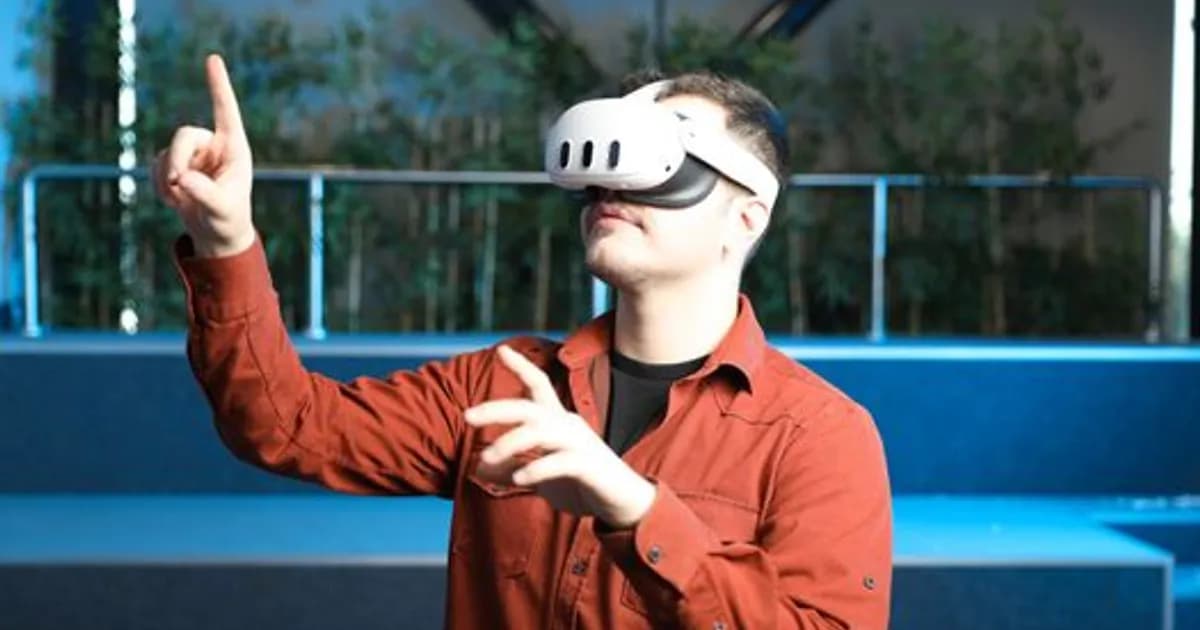
Mixed reality headsets — Apple Vision Pro 2 and the Microsoft HoloLens 3 sit at the high end. Both run spatial AI that understands room geometry, enables hand tracking, and overlays digital content that interacts with real surfaces. They're predominantly enterprise tools due to price.
AI-enhanced smartphones and tablets — the largest installed base for spatial AI. Most flagship phones in 2026 run real-time object recognition, AR translation, and live visual search without a network connection, handled by dedicated AI chips.
Key Applications Getting Real Traction
Several use cases have moved from prototype to daily use:
Field service and maintenance: Technicians wearing smart glasses receive real-time AI-guided overlays showing which components to inspect, step-by-step repair procedures, and fault detection alerts. Companies like Scope AR and PTC have production deployments with thousands of field workers.
Healthcare: Surgeons are using headsets with AI overlays during procedures to highlight anatomy, visualize scan data in 3D, and receive real-time measurements. Cleveland Clinic and Johns Hopkins have published results showing reduced procedure times and fewer complications.
Retail and warehouse: Amazon's warehouse AI vision systems now guide workers with spatial overlays indicating optimal pick paths. Retail stores use ceiling-mounted spatial AI cameras for inventory tracking and planogram compliance.
Education: Apps like Photomath's 3D mode and Google Lens's educational overlays bring spatial AI into classrooms. Students point devices at physical objects and get contextual information, historical timelines, and interactive models.
Navigation: Indoor navigation using AI spatial mapping is improving rapidly. Airports, hospitals, and large campuses use spatial AI to guide visitors with turn-by-turn overlays tied to exact room-level positioning.
AI + AR: What's Possible Right Now
The most practically useful spatial AI applications in 2026 share a few characteristics: they work offline or with minimal latency, they're context-triggered rather than always-on, and they don't require specialized hardware.
Real-time translation via smart glasses is one example. Point your glasses at a sign in Japanese, and the translation appears overlaid within about two seconds. Products like Google Gemini Glass and Apple's Vision Pro 2 both offer this.
Visual AI assistants that respond to what you're looking at — rather than what you type — are another. Meta's glasses with their integrated AI assistant can answer questions about objects in your field of view, read labels aloud, and identify landmarks.
The category that's growing fastest is spatial data capture for AI training. Companies are deploying spatial AI cameras in physical environments to capture structured data — room layouts, customer movement patterns, product interaction — that feeds back into AI models improving their world understanding.
Challenges That Still Limit Adoption
Battery life remains the binding constraint on wearable spatial AI. Running real-time computer vision on a device you wear on your face drains power faster than current battery technology can sustain for full workdays. Most smart glasses deliver four to six hours of active AI use before needing a charge.
Privacy concerns are significant and legitimate. Spatial AI devices with cameras generate continuous streams of visual data. Users in public spaces have not consented to being captured by other people's spatial AI devices. Several European cities have restricted always-on camera wearables in public settings, and the US is seeing similar legislative proposals.
Form factor constraints on smart glasses mean processing power and display quality are still limited. What looks impressive in a controlled demo can disappoint when the ambient light is wrong or the resolution isn't sufficient to read small text.
What's Coming Next
The roadmap for AI spatial computing in the next 12-24 months includes denser sensor arrays for more accurate depth perception, AI chips that deliver three to four times current performance at similar power envelopes, and standardized spatial data formats that let different devices and platforms share environmental maps.
Multi-agent spatial AI — where multiple devices in the same physical space share their AI perception and coordinate responses — is an emerging area that could make collaborative spatial work significantly more powerful.
For more on wearable AI hardware, see the AI Wearables in 2026 guide. For a broader look at how AI is layering into augmented reality, see AI in Augmented Reality 2026.
Conclusion
AI spatial computing has cleared the prototype stage and is delivering real value in field service, healthcare, logistics, and education. The hardware is still expensive, battery life is a real constraint, and privacy questions need better answers. But the trajectory is clear: the gap between the physical world and AI-powered digital information is closing fast.
If you work in a field where physical context matters — manufacturing, healthcare, retail, construction — now is the time to pilot spatial AI tools. The early adopters are already finding operational advantages.
Comments
Loading comments...