
AI Robotics in 2026: Humanoid Robots Are Going Mainstream
AI Robotics in 2026: Humanoid Robots Are Going Mainstream
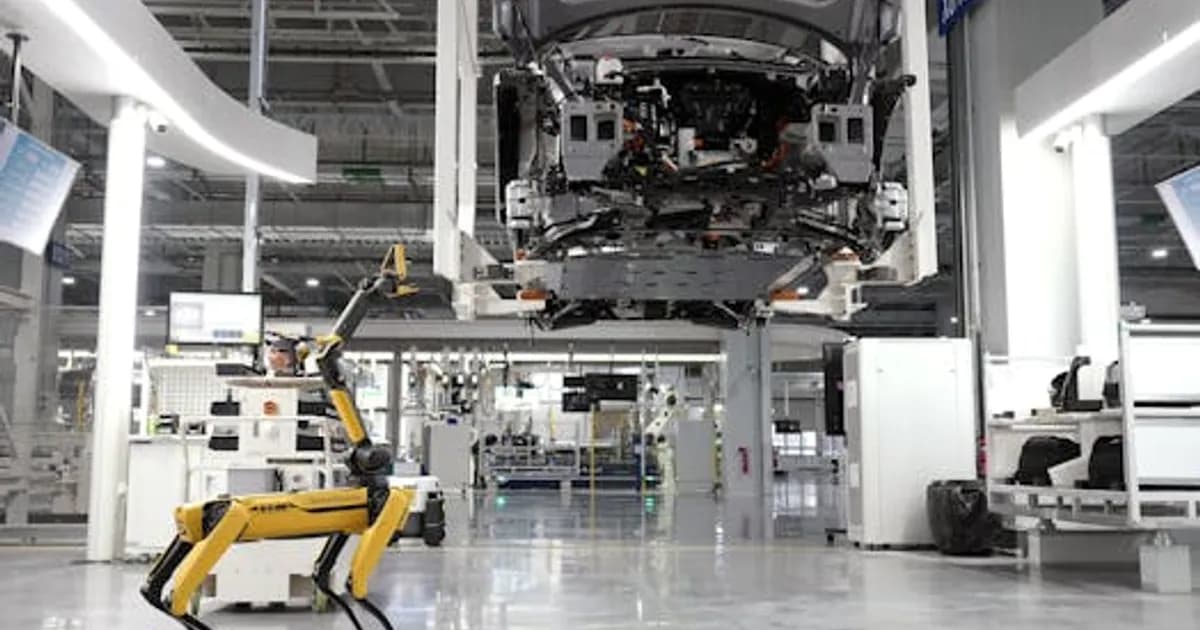
AI robotics in 2026 has made its first meaningful move from controlled demo environments into the real world. Not a press release. Not a warehouse pilot with a handful of units. Actual production deployments — measured in thousands of robots — performing real tasks in real facilities with real consequences when something goes wrong.
The numbers are still modest compared to industrial robotics overall. But the trajectory — and the technology behind it — is different from anything the field has seen before.
What Changed: From Lab Demos to Live Deployments
AI robotics in 2026 reached a tipping point because three previously separate advances converged at the same time.
First, foundation models that can interpret natural language instructions and visual context arrived in forms lightweight enough to run on embedded hardware. Second, dexterous manipulation hardware improved enough to handle variable real-world objects reliably. Third, training pipelines matured so that robots can learn new tasks without thousands of manually engineered examples — they generalize from demonstrations.
The result is robots that can handle variability. Earlier industrial robots were programmed for one task and failed the moment anything changed. Today's AI-powered robots reason about the environment rather than executing fixed motion scripts. That is the core shift in AI robotics in 2026.
The Companies Leading AI Robotics in 2026
Several players have pulled ahead of the field:
Figure AI deployed its humanoid robot, Figure 02, in BMW manufacturing facilities in late 2025. By mid-2026, the company has expanded to additional automotive clients and warehouse operators. The differentiator is a full-body manipulation system paired with a vision-language model that enables verbal task instruction without manual reprogramming.
Tesla Optimus (Gen 3) is the wildcard in AI robotics in 2026. Tesla's advantages — vertical integration, scale manufacturing expertise, and its own AI training infrastructure — mean that once the hardware is right, cost-per-unit drops fast. Optimus Gen 3, announced at Tesla's April 2026 product event, reports meaningful improvements in manipulation speed and load capacity.
Boston Dynamics pivoted its Atlas platform toward commercial deployment after decades as a research showcase. Its approach leans on proven, reliable hardware with newer AI integration layers, giving it a reliability edge over startups shipping first-generation products.
1X Technologies (formerly Halodi) focuses on a wheeled humanoid form factor for indoor commercial environments, targeting retail and hospitality. The wheeled base sacrifices stair-climbing ability in exchange for simpler balance control and higher uptime in flat-floor settings.
Agility Robotics and its Digit platform are live in Amazon fulfillment centers, handling bin-to-conveyor transfers at scale.
What Humanoid Robots Can Actually Do in 2026
Honest capability assessment matters here. AI robotics in 2026 is impressive but still bounded.
Deployed successfully:
- Repetitive pick-and-place in structured warehouse environments
- Parts assembly with moderate tolerance requirements
- Inventory scanning and indoor navigation
- Simple supervised household tasks (loading dishwashers, folding laundry)
- Security patrol and inspection in controlled indoor facilities
Not yet reliable:
- Unstructured outdoor environments with unpredictable terrain
- Tasks requiring fine motor manipulation at surgical or electronics-assembly precision
- High-speed operations matching industrial throughput levels
- Fully autonomous deployments in arbitrary home environments
The gap between a constrained warehouse and an arbitrary living room is still large. Most successful AI robotics deployments in 2026 work by constraining the environment rather than by building a robot that can handle anything anywhere.
The Hardware-Software Gap
One persistent challenge in AI robotics in 2026 is the gap between software capability and hardware reliability.
Foundation models for robot control have advanced faster than the dexterous manipulation hardware required to execute what those models plan. Finger joints that handle the force variation needed to pick up an egg without crushing it — and then place a heavy box without dropping it — require precision that remains expensive to manufacture at scale.
The companies closing this gap fastest are doing vertical integration: controlling the chip, the actuators, the control software, and the training pipeline in-house. NVIDIA's GR00T foundation model for robotics, Tesla's Optimus program, and Agility's Digit system all benefit from tight hardware-software co-design. Pure software plays that license hardware from third parties face more friction.
For a wider view of how enterprise teams are calculating returns on AI deployment, AI Agents in 2026: How Autonomous AI Is Reshaping Work covers the economics of autonomous systems across both software and physical contexts.
The Economic Case for AI Robots
Humanoid robots in 2026 are expensive. Figure 02 and comparable systems cost six figures per unit, plus integration and ongoing maintenance. The economics only work today in specific scenarios:
- High-labor-cost environments: warehouses and manufacturing facilities where labor is expensive and hard to source
- Safety-critical tasks: environments with high injury risk, hazardous materials, or extreme conditions
- 24/7 operations: robots don't take breaks, call in sick, or require shift differentials
The long-term bet is on cost curves. Tesla has publicly stated a goal of Optimus units under $20,000 at scale. If that trajectory holds, the addressable market expands dramatically — small businesses, restaurants, and eventually households enter the picture.
The Labor Question
It's impossible to cover AI robotics in 2026 without addressing labor impact directly.
The standard reframe — "robots take dangerous jobs, humans move to better ones" — is partly accurate and partly wishful. In manufacturing, transitions to robotic automation have displaced workers faster than retraining programs can absorb them in some regions. The geographic and demographic unevenness of that displacement is a real policy problem.
Separately, the use of AI robots for surveillance, security, and law enforcement contexts raises civil liberties questions the industry has not fully resolved. Regulatory frameworks are lagging the technology in most jurisdictions.
What to Watch in AI Robotics Through 2026
Several developments will shape the second half of 2026:
- Tesla Optimus Gen 3 production ramp: how fast can they scale, and what is the actual field reliability rate?
- Physical AI foundation models: NVIDIA's GR00T and similar platforms specifically for robot control are attracting significant investment and could accelerate capability improvement timelines
- Regulatory response: labor protection frameworks and safety certification requirements will determine which markets see deployments first
- Consumer robot entry point: when does the first credible sub-$30,000 consumer-facing product ship, and from which company?
Conclusion: AI Robotics in 2026 Is Real, but the Revolution Is Still Early
AI robotics in 2026 has passed the proof-of-concept stage. Real robots are doing real work in real facilities. The question is no longer whether AI-powered robots can work — it's how fast the cost curve drops and how quickly enterprises commit to the transition.
For businesses evaluating deployment, the calculation depends on your specific environment, labor costs, and tolerance for integration complexity. Controlled pilots are still the right entry point for most organizations in 2026.
For workers in affected industries, the practical response is proactive movement toward AI oversight, maintenance, and integration roles — positions that will grow as AI robotics deployments expand. The robots shipping in 2026 need humans to manage, train, and troubleshoot them. That need is growing alongside the deployments.
For a broader strategic perspective on where AI automation is heading, AI Agents Are Replacing Knowledge Work in 2026: What to Know examines how organizations are restructuring work around both software agents and physical automation systems.
Comments
Loading comments...