
AI in Manufacturing 2026: Robotics, Automation, and Real Results
AI in Manufacturing 2026: Robotics, Automation, and Real Results
Manufacturing was one of the first industries to pilot AI, and it's one of the first to move past pilots into broad deployment. In 2026, AI in manufacturing isn't a future capability discussion—it's an operational reality on factory floors across automotive, electronics, food processing, pharmaceuticals, and heavy industry.
The results aren't uniform. Some applications have delivered on their promise; others have proven harder to scale than early trials suggested. Understanding which is which matters for manufacturers still evaluating where to invest.
Predictive Maintenance: The Proven Application
Predictive maintenance is the most mature AI application in manufacturing, and the business case is now clear from enough deployments to trust. The premise: sensor data from equipment—vibration, temperature, pressure, acoustic signatures—can predict failures before they happen.
A typical deployment reduces unplanned downtime by 25–45% in the first year. The math is straightforward: unplanned downtime in a continuous production environment costs an order of magnitude more than planned maintenance. Equipment that runs to failure also tends to cause secondary damage and quality problems that planned maintenance prevents.
What makes predictive maintenance AI different from traditional threshold-based monitoring is that it learns the normal operating pattern of each specific machine and detects deviations—including subtle drift patterns that precede failure by days or weeks. Traditional thresholds catch failures when they're already happening; AI-based systems catch them in the approach.
The implementation requirements are real: IoT sensors on key equipment, data infrastructure to collect and process readings in near-real time, and a maintenance team trained to act on AI alerts rather than ignore them. The last point is often underestimated. Predictive maintenance systems fail not because the predictions are wrong but because organizations don't build the response process to act on them.
Quality Inspection: Computer Vision at Scale
Visual quality inspection—the process of identifying defects in products or components—has been transformed by computer vision AI. Cameras, combined with AI models trained on defect images, inspect products at line speed with accuracy that exceeds human inspection for most categories of visible defects.
The advantages of AI inspection over human inspection:
- Consistency: Humans fatigue; camera-based systems don't. The detection rate of AI systems doesn't drop at the end of a shift.
- Speed: Computer vision operates at the speed of the production line without creating bottlenecks.
- Documentation: Every inspection is logged with a result and, typically, an image capture. This creates traceability that manual inspection can't provide.
- Adaptability: When defect patterns change—as happens when a supplier changes a component spec or a new product line launches—the model can be retrained on new images within days.
The category where AI inspection has clear limitations is complex 3D geometry and defects that require tactile detection rather than visual. For printed circuit boards, surface coatings, and precision castings, AI inspection is reliable. For some assemblies, human inspection or CMM measurement remains necessary.
Robotic Assembly: Progress and Remaining Gaps
Robotic assembly has been commercially deployed in manufacturing for decades, but traditional robotics required fixed, controlled environments. AI-powered robotics—specifically, systems that combine vision, manipulation, and machine learning—are handling tasks that rigid robotic systems couldn't.
What's working in 2026:
- Bin picking: AI-guided robots pick randomly oriented parts from bins without requiring parts to be presented in a fixed orientation. This was a major bottleneck in automating assembly lines.
- Flexible assembly: Robots that can adapt to product variations without being reprogrammed for each variant.
- Human-robot collaboration: Cobots (collaborative robots) with AI-enhanced safety systems that allow them to work alongside humans without fixed physical barriers.
- Inspection-and-rework loops: Robots that inspect their own work and make corrections before moving to the next step.
Where gaps remain: fine manipulation tasks requiring dexterity close to human fingers, assembly in unstructured environments where conditions vary significantly, and tasks requiring force feedback that current sensing technology doesn't provide reliably enough for high-stakes assembly.
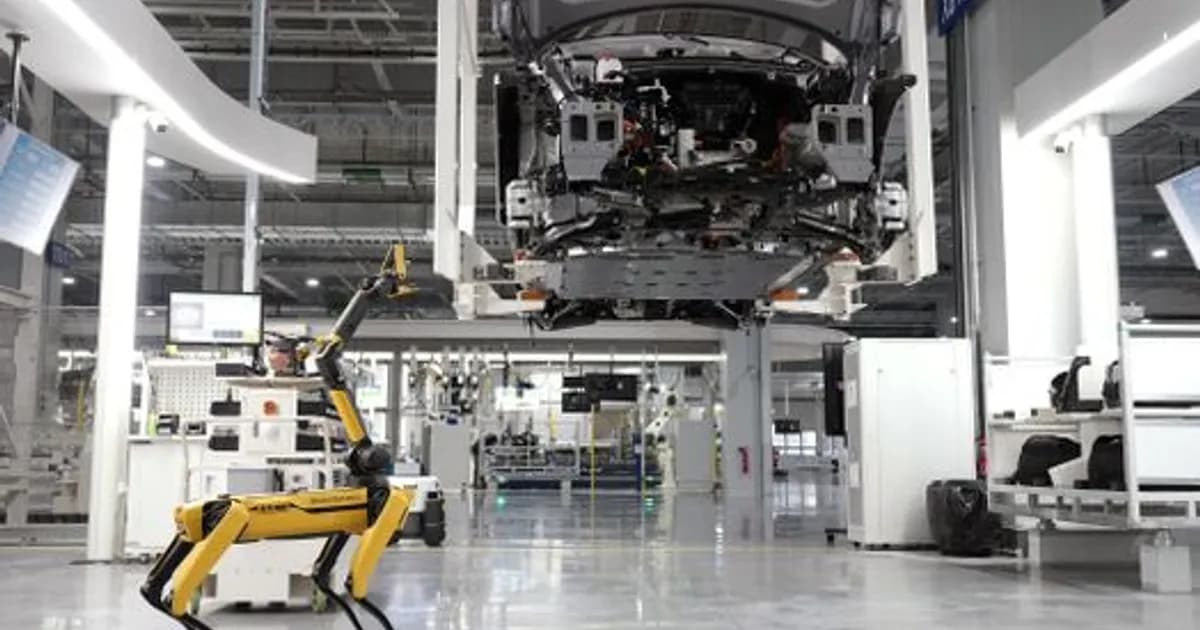
The major robotics manufacturers—Fanuc, KUKA, ABB, and Boston Dynamics for mobile applications—have all integrated AI capabilities into their product lines. The barrier to deployment has shifted from technology availability to integration expertise and total cost of implementation.
Supply Chain Optimization
AI-driven supply chain optimization has become a significant competitive differentiator in manufacturing. The core applications:
Demand forecasting: AI models that incorporate not just historical sales data but also external signals—economic indicators, social media trends, weather, commodity prices—to forecast demand more accurately than statistical methods. Better forecasts reduce both stockouts and excess inventory.
Supplier risk monitoring: AI systems that monitor supplier financial health, geopolitical conditions, and logistics disruption signals to provide early warning of supply chain risks. The COVID-19 and subsequent supply chain disruptions of the early 2020s created massive investment in this capability.
Production scheduling: AI-based schedulers that optimize production sequence in real time as orders change, constraints shift, and equipment status varies. Traditional scheduling software optimizes at the start of a planning period; AI schedulers re-optimize continuously.
Logistics optimization: Route planning, carrier selection, and warehouse picking optimization that reduce cost and improve on-time delivery.
The scale of impact varies significantly by industry. Automotive and electronics manufacturers—where supply chains are complex and disruptions are expensive—have seen the largest returns. Process industries with simpler supply chains have seen more modest benefits.
The AI chip shortage challenges have paradoxically accelerated AI adoption in manufacturing of semiconductors and electronics, as companies have needed to squeeze more output from constrained supply.
Energy Management
AI-based energy management is an emerging application that's gaining traction as energy costs rise and sustainability commitments become binding. AI systems analyze energy consumption patterns across a facility, identify waste and optimization opportunities, and in some cases control energy-intensive systems directly.
The applications:
- Load shifting: Moving energy-intensive processes to off-peak periods when electricity is cheaper or when renewable energy availability is higher
- Compressed air optimization: Compressed air systems are notoriously inefficient; AI monitoring identifies leaks and optimization opportunities
- HVAC optimization: AI control systems reduce HVAC energy consumption while maintaining production environment specifications
- Process energy efficiency: In energy-intensive processes like aluminum smelting or glass production, AI process control reduces energy per unit of output
For manufacturers with large electricity bills and sustainability targets, energy management AI has payback periods measured in months, not years.
Implementation Realities
The factories that have captured the most value from AI in 2026 share a few characteristics that are worth understanding before launching new programs:
Clean, accessible data: AI systems require reliable sensor data, connected equipment, and data infrastructure that many older factories don't have. The technology investment that precedes AI deployment—sometimes called "digitization"—is often larger than the AI investment itself.
Clear use case prioritization: Factories that tried to implement AI broadly and simultaneously have generally struggled. Those that picked one or two high-value applications, achieved measurable results, and then expanded have a much better record.
Workforce integration: Factory workers' relationship with AI systems—particularly inspection and quality AI that might evaluate their work—matters for adoption and effectiveness. Programs that include workers in system design and provide transparency into how AI reaches conclusions have better outcomes.
Vendor ecosystem: The market for industrial AI is still fragmented. Domain-specific vendors often outperform general AI platforms for specific manufacturing applications. Evaluation should focus on demonstrated results in similar production environments, not benchmark performance.
What's Next in Industrial AI
The next phase of AI in manufacturing involves more sophisticated autonomous decision-making. Systems that currently flag anomalies for human review are being extended to take corrective actions directly—adjusting process parameters, rerouting work orders, or triggering maintenance actions without waiting for human approval.
The question this raises is accountability. When an AI system makes an autonomous production decision that affects product quality, safety, or worker conditions, the accountability chains are different from those of a human supervisor. The industry is working through these questions now, before autonomous manufacturing AI becomes ubiquitous.
Digital twins—virtual models of production systems that run AI simulations before implementing changes on the physical floor—are also maturing rapidly. The combination of real-time AI monitoring and digital twin simulation gives manufacturers a powerful tool for optimization that avoids the trial-and-error costs of testing on actual production lines.
Manufacturing AI in 2026 is delivering real results. The next three years will determine whether the technology matures into the comprehensive operational intelligence platform its proponents envision—or whether the remaining gaps in autonomy and adaptability limit it to its current, still-valuable set of applications.
Comments
Loading comments...